
40 Years Teaching College Composition


a teacher
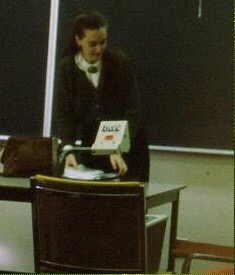
As a young teacher
I’ve been fully retired for a year and a half now, and I deleted all my teaching files a couple of months ago, so I can’t pass along any specific course materials. For Labour day, though, I’m going to share the distillation of my 40 years of teaching college composition and other language skills to college and university students, and my studies on how people learn to write from two advanced degrees in mid and late career.
1. Many community college students come in already resistant to taking English, and convinced they can’t write. It was my experience that many students were dyslexic and/or discouraged. Many believe that if they can’t write grammatically perfect, with no spelling errors, first drafts, that means they can’t write. They’re wrong, of course, but it takes a while to convince them. And sadly many college English courses insist on using the same decontextualized drill and kill exercises that had no benefit for them in their high school English courses.
Here’s what works in my experience.
  • Whenever possible, get students writing about something they know about and care about. Many of my students were visual, so I’d get them describing what they could see. Sometimes it helps to get them to describe how to do something they are good at, and encourage their use of detail.
  • Remind them over and over, directly and indirectly, that their first efforts will be messy and encourage them to NOT WORRY about messy-looking, roughly planed first drafts.
  • I learned how to make it a ritual to start classes with what I called a “free write” – students had to turn off their screens or reduce the page to an unreadable size, and then I’d set a timer for five minutes. The rule was that they had to write about whatever they wanted to and they couldn’t stop and think, they couldn’t stop moving their fingers; they had to constantly be writing. If they had nothing to say, they had to write something like, “I have nothing to say” over and over till they had something to say. After the 5 minutes were up, I never looked at what they written, but they could use any ideas or stuff they’d written for class assignments, or not. Some thought it was a waste of time but if you have them do it, and model for them by doing it yourself too, with them, at the very least their keyboarding facility increases, and often their ability to string words together gets stronger too.
  • Sometimes I’d have students work in pairs or small groups and read their drafts aloud to each other. This helps them feel the flow of what they’ve written and gives them ideas from hearing each other’s work.
  • I had 3 rules for feedback –
    1. Everybody has to give solid feedback to everybody. No “correcting” or suggesting allowed.
    2. Ask questions where you the reader / listener need more information to understand or are just curious and want to know more. (This helps students learn more about audience reactions.)
    3. Tell writers SPECIFICALLY what you like. Never, never. Never just say “That’s nice.” And let it go at that.
  • Put them to work. There are a lot of sites that give writing and grammar advice, like, for example, Grammar Girl – http://www.quickanddirtytips.com/grammar-girl – get students to find as many as they can and maybe have them compare them in small groups, or do brief presentations on why they think they’re helpful, or not. This sets them up, possibly, to know how to support their writing when they’re working independently in other courses or on the job.
Some technical suggestions:
  • If you’re in a computer lab, I’d suggest you get them on Google Docs – they can access their Google Account on their own or other computers or tablets and work outside of class. Google Docs is similar enough to Word that it’s no trouble to learn and it’s free.
  • If you create a PowerPoint and you want them to have a copy, move it to, or create it in, Google Slides because you can then give them a link and they can access it themselves.

Much respect and gratitude to those teaching as this new school year starts!

Good luck and happy teaching,

Writing and Reading (Old Tech)

image

You are reading
this,
far away
from the time and place
where/when synapses
fired
their ballet
and I thought
a feeling
a rhythm
holding these words –
first sliding in black
ink
on a page,
waiting
for synapses
and time
and fingers
taping
green life
through electric connections to a screen
that holds
and releases
thoughts, words
reconstituted
regained
and printing up,
through black tape,
in a rhythm
of line and page
these words
which bend
and fold –

and, enveloped, travel
to be studied,
held,
approved.
A bored stranger submits
these words,
through the finger ballet, to the machine that prints
these words
for you
to read
now.

Learned or Learner: Do you learn more than your students do? — Douchy’s Blog

A big part of the teacher’s role has always been to serve as an example to their students, of what it looks like to be educated. When knowledge was the key to future success, a teacher was the living, breathing example of a learned person. Students could look up to their teachers and aspire to […]

via Learned or Learner: Do you learn more than your students do? — Douchy’s Blog

Free Online Resources: Grammar and Writing — Kristen Twardowski

Like any good grammar junkie, I keep a list of resources for when questions arise about the English language. The following are some free sites that I find myself referring to time and time again. They have been so helpful over the years that it would feel stingy not to share them. OWL: The Purdue […]

via Free Online Resources: Grammar and Writing — Kristen Twardowski

Coffeeshop Conversation

Coffee cup

Air-conditioned coffee shop,
conversations bleeding into
silent tables,
voices speaking about conceptions
of God
or meditation

And addictions.
And relationships.

I want to interrupt
but don’t.

I wonder if I
arrived here
drawn
by those invisible connections

The Enlightenment
has denied me.