
What the sun says in passing …

The remains of beauty.
Figuring Out Life While Aging

What the sun says in passing …
The remains of beauty.

Lately I keep ‘seeing’ the contrasts and correspondences of current urban architecture and how it frames itself. Digital cameras entice me to practice seeing what I see.
I saw “Knocked Up” a couple of nights ago, and I was underwhelmed. What I had expected to focus on a highly female experience was told from the point of view of immature males. First, to respond at the depth the movie encouraged, that is, shallowly, I couldn’t believe the couple. The woman, Kathleen Heigl, was beautiful, and she can act; I’ve seen her in Grey’s Anatomy. The male lead was about as unlikely as possible, and certainly no pleasure for females to look at. (Did I mention “shallow”?)And he declaimed rather than acted. I couldn’t feel any chemistry between him and Kathleen Heigl, or, indeed, between him and his future brother-in-law. He was the geeky guy who got, so to speak, the girl, and thus the projection of male fantasies.
The jokes and gags were male-oriented; it was a story about how one of the gaggle of pointlessly-stupid males got cut from the herd. From the bong jokes to the practical-joke jokes, it was male sentimentality and gross-out humour all the way. Even the sex scene was about the male’s problems with sex with a pregnant woman, not about her experience, except for her frustration at his irrational idiocy.
One contrast to this male-oriented approach did exist. Kathleen Heigl kept her bra on and her butt covered in all the sex scenes while he had his ass clearly displayed on camera – no treat that! However, there were improbably large breasts displayed in the nightclub scene to balance Heigl’s dignity.
I had read that “Knocked Up” was a “sweet” story of young people taking responsibility and “growing up”. What I saw was a version of the “Animal House” approach applied (quite improbably) to a situation that could have been seen in a less shallow and more nuanced way.
I give it a finger down the throat.

All my life, since I was 4, September has meant that school starts again. I remember in grade school, promising myself that this year my notebooks would be beautiful, that I wouldn’t make messy mistakes in them. Always, September meant the chance to see old friends who were somewhere else over the summer, the chance to find a new friend who would truly understand me and like me, the chance for something wonderful to happen. Is it any wonder that I find September an exciting yet anxious month?
I have trouble understanding numbers, however visual images make sense to me.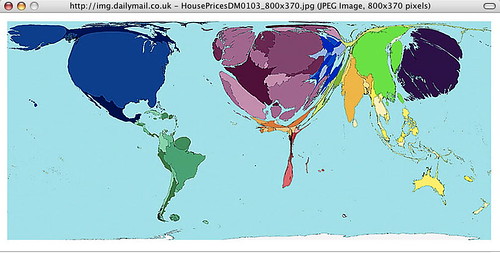 This shows house prices around the world, and I “get” it.
Check out the Daily Mail link to see how the following are spread out over the world: alcohol consumption, HIV prevalence, house prices, military spending, war and death, toy imports, toy exports, the wealth of nations in 1500, and the wealth of nations in 2002.
Geography and political science teachers should be using this kind of visualization, IMHO, so students who are visual can understand even if they are numbers-blind.
500 Years of Female Portraits in Western Art
Web 2.0 art – it reminds me of a music video from years ago where faces continuously and rapidly morphed into others – “Cry” by Godley and Creme – read about it here
The changes in what can be done on the web are massive and occurring very quickly, which makes it hard for digital immigrants (most of us older than 25 – 30) to keep up. Yet we teachers need to know what world, what culture, our students are living in. Sometimes we can learn from our students, and get a vivid sense of what excites them; sometimes research can gives us the big picture.
Henry Jenkins, Director of the Comparative Media Studies Program at the Massachusetts Institute of Technology has published this white paper, Confronting the Challenges of Participatory Culture: Media Education for the 21st Century that explores new frameworks and models for media literacy.
A central goal of this report is to shift the focus of the conversation about the digital divide from questions of technological access to those of opportunities to participate and to develop the cultural competencies and social skills needed for full involvement. Schools as institutions have been slow to react to the emergence of this new participatory culture; the greatest opportunity for change is currently found in afterschool programs and informal learning communities. Schools and afterschool programs must devote more attention to fostering what we call the new media literacies: a set of cultural competencies and social skills that young people need in the new media landscape. Participatory culture shifts the focus of literacy from one of individual expression to community involvement.The new literacies almost all involve social skills developed through collaboration and networking.These skills build on the foundation of traditional literacy, research skills, technical skills, and critical analysis skills taught in the classroom. (Bolding added)
The whole paper can be downloaded from – http://tinyurl.com/yyrdpl
Even reading just the two page Executive Summary will give you lots to think about. And the concluding statement shows the dangers of ignoring the new participatory culture Jenkins is writing about:
The Challenge Ahead: Ensuring that All Benefit from the Expanding Media Landscape
Writing in the Chronicle of Higher Education (May 19, 2006), Bill Ivey, the former chairman of the National Endowment for the Arts, and Steven J.Tepper, a professor of Sociology at Vanderbilt University, described what they see as the long term consequences of this participation gap:
Increasingly, those who have the education, skills, financial resources, and time required to navigate the sea of cultural choice will gain access to new cultural opportunities….They will be the pro-ams who network with other serious amateurs and find audiences for their work.They will discover new forms of cultural expression that engage their passions and help them forge their own identities, and will be the curators of their own expressive lives and the mavens who enrich the lives of others….At the same time, those citizens who have fewer resources—less time, less money, and less knowledge about how to navigate the cultural system—will increasingly rely on the cultural fare offered to them by consolidated media and entertainment conglomerates… Finding it increasingly difficult to take advantage of the pro-am revolution, such citizens will be trapped on the wrong side of the cultural divide. So technology and economic change are conspiring to create a new cultural elite—and a new cultural underclass. It is not yet clear what such a cultural divide portends: what its consequences will be for democracy, civility, community, and quality of life. But the emerging picture is deeply troubling. Can America prosper if its citizens experience such different and unequal cultural lives?
Ivey and Tepper bring us back to the core concerns that have framed this essay: how can we “ensure that all students benefit from learning in ways that allow them to participate fully in public, community, [Creative] and economic life?” How do we guarantee that the rich opportunities afforded by the expanding media landscape are available to all? What can we do through schools, afterschool programs, and the home to give our youngest children a head start and allow our more mature youth the chance to develop and grow as effective participants and ethical communicators? This is the challenge that faces education at all levels at the dawn of a new era of participatory culture.
This is a rich and inspiring read for all who are involved in education.
Jenkins, Henry. “Confronting the Challenges of Participatory Culture: Media Education for the 21st Century.” Digital Media and Learning (2006). 27 Apr. 2007 .
I can’t resist showing you this website –
It looks, and in some ways is, low tech but it has its own url and isn’t a web 2.0 application, so it has some high tech elements. However, what I loved about it is the concept. I read through to the end because of the creative approach. It is different and very amusing.
I’ll probably buy the book;->
Thanks to Gloria – http://www.ohouse.ca/ – for the link
 clipped from spotlight.macfound.org clipped from spotlight.macfound.org
|
I believe that (most) technology is neutral; it’s how people use it that makes it good or bad. It is curious that humans pay more attention to the relatively few predators than to the far larger problem of bullying, which is growing in our culture, not just online. Look at some of the most popular reality TV shows for examples.
Link courtesy of Stephen Downes – http://www.downes.ca/cgi-bin/page.cgi?post=39533,
From BlogSafety.com – http://www.blogsafety.com/thread.jspa?threadID=1100000263&tstart=0
Cyberbullies
Now let’s look at a very different number deserving of parental attention: peer harassment, or cyberbullying. Compare the figure of 100 adult-to-minor predation cases in 2005 to 6.9 million “cases” of teen-to-teen cyberbullying. The latter number comes from a 2006 study by criminology Profs. J.W. Patchin and S. Hinduja which found that 33.4% of US teens have been victimized by cyberbullying (see “Bullies Move Beyond the Schoolyard”). According to Jupiter Research, there were 20.6 million US teens online by the end of last year. One third (33.4%) of 20.6 million suggests 6.9 million incidents of cyberbullying. These are the best figures we have on the noncriminal, peer-to-peer side of the social Web’s risk spectrum, but are actually much better numbers (based on sound research methodology) than the 100 cases of sexual predation compiled from news media stories. The CACRC researchers tell me they’re starting work on a study that will update and vastly improve on that 100-cases figure, but it won’t be publicly available for over a year.
I find it interesting too, that I’ve never seen the positives of social networking highlighted before either:
[And consider one more notable number on the positive side of social networking: MySpace is the source of more than 100,000 visitors a year to the National Suicide Prevention Lifeline’s Web site. It’s the hotline’s single biggest source of referrals… .]
So the web is neither good nor evil; it is simply a communication channel for humans.


 Learning Living