MySpace + YouTube = The Global Village

You can see the enormous changes in communication that have occured in the last few years by looking at MySpace and YouTube.

We live in a global village, as Marshall McLuhan predicted in the 1960s. My daughter, an active MySpace participant, told me several weeks ago about a group she’d discovered through MySpace called Gnarls Barkley. She talked with great energy and enthusiasm about noticing the spread of their music in Toronto, hearing it on the street, and finding people who already knew about it. This was not formal advertising, but the new “word-of-mouth” based on social networks such as MySpace.

GnarlsVid.jpg

When I heard that I could see the Gnarls Barkley video for their song “Crazy” on YouTube, I searched for it, and found it there. The lyrics are great, and the video is striking, both beautiful and interesting But that’s not what this post is about. What is amazing is that in a very few weeks, this music and video spread “virally”, as they say, through the social networking sites, MySpace and YouTube.

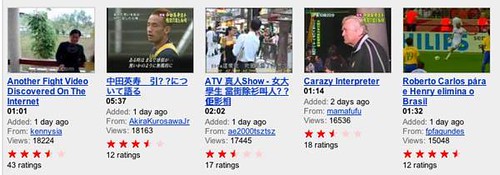
Most of the social netwarking I look at is in English, my language. But YouTube uses videos, a more univeral language of images. We may not uderstand what is on the audio (or what they were thinking, for that matter) but there can be no doubt that we are only part of the world.
YouTube.jpg

Look at the variety of languages that show up on YouTube. The Web shows us that we live in a global village, and the ease with which people can put content on the Web shows us how the enforced passivity of movies and television is being superceded by the activity of posting on the Web, whether it be homemade or professionally produced content.

To me, this worldwide activity is what is most amazing about the Web.

technorati tags:, , ,

Blogged with Flock

Elgg Described, with Examples

Supporting online communities with Elgg

by Josie Fraser, with help from Sasan Salari

Elgg is an open-source social software programme which is free for institutions to download and use. Elgg provides an excellent way to investigate e-portfolio provision or to support your college communities online. By laying out a number of scenarios, this article clearly highlights the benefits of Elgg, and demonstrates its …

This description of the various aspects of Elgg, followed by examples of how students and/or teachers can use them is inspiring, in the deep meaning of the word. You can breathe in ideas, circulate them through your experience, and imagine possibile uses. My own experience of using an Elgg Community blog for a class last term matches what the authors describe, and I have seen some new possibilites for my teaching in the fall.

Great article – very practical, with helpful images. I recommend it.

technorati tags:,

Blogged with Flock

Connectivism vs Constructivism – G. Siemens

A succinct and clear look at how we learn and learning theories. Siemens says:

Most learning needs today are becoming too complex to be addressed in “our heads”. We need to rely on a network of people (and increasingly, technology) to store, access, and retrieve knowledge and motivate its use. The network itself becomes the learning. This is critical today; the rapid development of knowledge means that we need to find new ways of learning and staying current. We cannot increase our capacity for learning ad infinitum. We must begin to conceive learning as socially networked and enhanced by technology (it’s a symbiosis of people and technology that forms our learning networks). We need to acknowledge our learning context not only as an enabler of learning, but as a participant of the learning itself.

We rely on Google, libraries, friends, social bookmarks/tags, etc. to serve as our personal learning network (we store the knowledge external to ourselves). When we need something, we go to our network (know-where is more important than know-how or know-what)…or we expand our network. In the end, the constant act of connecting in order to stay current is a much more reflective model of learning than constructivism.

Connectivism Blog

That matches my experience as a learner.

Also very interesting, the

matrix posted by Derek Wenmoth on online learning (including a continuum of learning theories)

Connectivism Blog

http://blog.core-ed.net/derek/archives/001082.html

A final note – I think using the Flock blogging tool is helpful, but it does alter my style.

technorati tags:, , ,

Blogged with Flock

Flock – One-Stop Web Browsing

I was checking what was happening on the SocialLearning.ca site and saw D’Arcy’s post –

Flock Beta 1 Available Now | SocialLearning.ca.

Finally, I thought, someone is pulling things together for the user – a Web 2.0 (social) browser that is a one-stop space.

So I decided to play with it.

I like it. A lot! In fact, I’m creating this blog using all the integrated bits, from putting my screenshot into Flickr and then into this blog post, all in one window. And the Favorites link to del.icio.us, so I can tag them for future reference. I haven’t used the aggregator because I’m happy with Bloglines, but I would recommend using the Flock newsfeeds to anyone who has been thinking about using an aggregator, but hasn’t set up their own Bloglines account yet. That way you would have everything you need, including a Search space, right in the same browser.For more detailed information, check out http://paulstamatiou.com/2006/06/15/the-definitive-flock-beta-1-review/

Using Flock gives me a simpler interaction and saves me time. So I’m really impressed, so impressed, in fact, that I’m making Flock my default browser.

Give it a try – see what you think.

Blogged with Flock

tags

Blogged with Flock

Social Software & Academic Commons

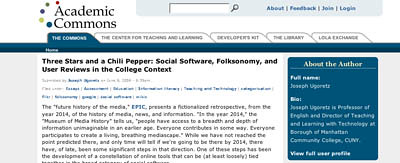
If you want to understand the “big picture” of the impact of social software on education, including the problems, I suggest you go to the Academic Commons and read Joseph Ugoretz”s Three Stars and a Chili Pepper
AcademicCommons

Ugoretz starts from this premise:
Social software includes many communication media, but the new tools which are the subject of this essay all fit three broad descriptions. These tools are interactive, with the content created and structured by a wide mass of contributors. These tools are also interconnected, with user-provided searchable links structuring and cross-referencing that content. And finally, these tools are bottom-up and communitarian, with the users of the tools providing and benefitting from associations, reputations, and authority within a many-to-many community. The various tools of social software are an increasing presence in the online world, as well as the offline lives of their users.

He uses anecdotes and clear explanations.

I recommend it.

tags

A New Resource for Learning

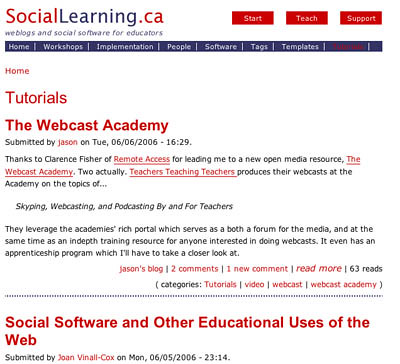
I’ve been playing on (with?) a new resource for learning and teaching called SocialLearning.ca
SocialLearning
You can learn a lot on this site. For direct learning, take a look at the Tutorials section – the link is on the far right on the navbar at the top.
Soclearn2
You can also learn by exploring a little using the (right)sidebar to click on tags or other links –
SocLearn3
And finally, you can learn by exploring the navbar at the top. For example, by clicking on “Software” you will find information on various software that SocialLearning.ca members recommend and/or describe.
If, as a teacher, you have trouble filling your time during the summer (;-> irony alert!) you could spend at least some of your “free” time exploring and learning from this site.

tags


Tagging – for Bookmarking Favorites

Tagging is an essential tool for anyone who wants to find interesting Websites again sometime in the future. In a previous post, I explained tagging, using extensive quotes from Ellyssa Kroski’s post, The Hive Mind: Folksonomies and User-Based Tagging at InfoTangle. It’s still an excellent starting point for understanding the significance of tagging. However, sometimes “quick and dirty” howto’s are all someone wants to know. With that in mind, here’s a link to –
TagTechSoup
Thirteen Tips for Effective Tagging, an excellent post on the “how’s” of tagging with del.icio.us. For example:

Below are some tips for choosing tags on del.icio.us from Web Consultant Alexandra Samuel.

1.
Be a lemming. Check how other people are tagging the kinds of sites you want to remember. Del.icio.us Linkbacks makes this very easy. Bear in mind that different people will bookmark the same site for different reasons: I might bookmark Terminus 1525 as a great example of a Drupal site, while you are saving it as a link to young Canadian artists.
2.
Follow the herd. When in doubt, pick the tag that seems to have the most links — this is the leading tag of the options you’re considering, so hopefully will emerge as the dominant focal point (so you don’t have to check “open-source,” “opensource,” and “open_source” to keep on top of the big world of open source).

I recommend the whole post, and suggest you bookmark it using del.icio.us ;->

tags


Matthew McKinnon on Web Megasites

CBCFreshMeet
The Web can be a confusing and therefore intimidating space. Matthew McKinnon, published on CBC’s Arts & Entertainment Website, gives the clearest map I’ve seen:

Think of the web’s old guard as TV networks — they provide mainstream programming for amorphous audiences — and its young turks as cable channels, offering niche content to avid subscriber bases.

The leaders of this new school excel at creating online communities. MySpace, YouTube and Flickr function as self-contained planets in cyberspace; Blogger is chief architect of the blogosphere. All of them encourage their users to contribute content, engage in conversation and form personal relationships. It’s a totally different tao of building traffic: Yahoo! takes you places, MySpace means you’re already there.

Settle in, and get a load of the big stars of the net’s new wave…

Here’s the link to his article: http://www.cbc.ca/arts/media/megasites.html.

Enjoy!

tags


Connecting the Dots – CCHRD’s 2006 Conference

CCHRDwiki
Some conferences are just great, and this was one. Today I attended the CCHRD (College Committee on Human Resources Development) Central Region (Centennial, Seneca, George Brown, Sheridan, Mitchner Institute) Conference called Connecting the Dots. The one & a half hour rush-hour commute was not fun, but shortly after I arrived, I was greeted by two women, one of whom, with a lovely warm smile, told me she reads this blog! It was exciting to meet a such a positive reader!

Then Dr Marcel Danesi spoke, and he’s wonderful! He talked about the fact that academic researchers don’t actually know how people learn, however the person and their background, both personal and cultural, are at the core. He went on to affirm that human contact is central to teaching. Yes. I agree totally.

As a teacher you have to shut up and listen, which is part of becoming wise, and part of seeing your students as researchers of what you both are interested in. Absolutely! You want your students’ respect, not their friendship. You want to be a “wise elder” and their mentor.

I can’t possibly impart the flair and humour of his talk, but I enjoyed and benefitted from it.

The students on the student panel had interesting comments and insights.

The morning workshop session I went to was called “Popular Culture and Critical Media Literacy” given by Lena Carla Gutekunst, and it was very interesting. She’s an engaging speaker with real insight into the culture many of our students live in, and how to teach critical thinking using (and respecting) it.

Lunch was great, as was the conference space Centennial had provided.

I presented on Blogs, Wikis and Students in the afternoon, and was grateful for the help I got from the sound man and a quiet stranger I later realized was Dr. Sandy Shugart, the closing keynote speaker. I loved talking about Web 2.0, and how it helped my students connect with each other, and how it gave them a real context for communicating with each other. (If they didn’t reseach, present and post on the wiki, their fellow students wouldn’t learn what they needed to learn.) And the subtext to both the class and the presentation, was that my students had engaged with each other because they had heard each other’s stories, and had been heard when they told their stories.

The Web, my message was, is easy and allows our students to communicate in ways they find meaningful, using a technical tool they are familiar with, though they might have to learn some new elements. It is a powerful teaching/learning tool, especially when combined with face-to-face time in class.

Dr Sandy Shugart gave the closing keynote and what a wonderful note to close on. He spoke holding, and occasionally playing his guitar. He talked about Robert Frost’s “Two Tramps in Mud Time” and how our work can deform us, how it can be a shrinking prison, or how it can be a crucible, where we are transmuted into our full humanity. He spoke about how important it was to a “servant leader” – and he sang great lyrics. I was very glad I’d stayed (instead of leaving early to miss the traffic). I needed to hear what he was saying, at many levels. Here’s a description of him – http://www.imakenews.com/orcc/e_article000400176.cfm?x=b11,0,w

A lovely, rewarding day!

tags