Resistance to Teaching Online

Christopher D. Sessums’ blog post Resistance is Useful: Thoughts Concerning How to Respectfully Move Teaching and Learning Online a commentary on education in the online age is an interesting and thoughtful piece. He concludes:

Whether you are teaching online or face-to-face, educators are presented with a number of challenges in getting students to adopt skills and demonstrate intellectual and practical dexterity of many complex concepts. We might even say, teaching and learning is all about being open to and coping with perpetual change, taking calculated risks. Many academics view online teaching and learning with suspicion, and rightly so. Today’s learning technologies will revolutionize and affect colleges and universities as we know them. Faculty and administrators should be aware of the changes technology affords and question the implications deeply and critically. This act of looking critically should not stop at the technological level; it needs to consider the entire range of operations that comprise the acts of administration, teaching and learning; from the effectiveness of tenure and promotion policies to the effectiveness of multiple-choice high-stakes student examinations.

I have been teaching in face-to-face classrooms using laptops (for the “mobile” programs) with the web and WebCT, for over six years, and I largely agree with his analysis. However, I am going to comment on two aspects that are probably beyond the scope of his article.

First, the students today write, read, and learn differently than they did even five years ago. (I have an article that expands part of this point at ) Increasingly we teachers will have to learn how to help students learn how to learn in their new semiotic landscape. And we are digital immigrants ourselves!

In addition, the students, even the technologically proficient among them – and that’s fewer than many people assume, need to learn critical thinking skills about the sea of content they swim in on the web. This worries me tremendously because so few educators are taking leadership in this vital area, in my opinion. Which brings me to my second aspect …

The web is a multi-media platform, rich in visuals and sound as well as text. Almost all educators got their credentials in a text-focussed environment. Many of them (us?), I believe, fear the web (quite rationally) because it requires abilities and even perceptual training that they simply don’t have. The story of what happened at Sheridan when we put thousands of students – and their teachers – into a mobile environmentover a very few years which I lived through, illustrates the kind of learning community that can develop and support educators in this transition, and how some adapt and some resist, no matter what the circumstances.

I agree with Sessums that the “the entire range of operations that comprise the acts of administration, teaching and learning” need both a critical examination and change as rapidly as possible.

My Failed Podcasting Experiment

If you click on the title, you will hear my brief podcast on how Walter Ong’s concept of “secondary orality” – the orality that comes after text literacy, or with text literacy. I am in the classic learning-by-doing mode. First I used Blogger’s Audio-Blogging tool and phoned in a blog. (See the post below.)

For this podcast, I used Audacity to create a recording, and iTunes (on my iBook)to reduce the size of the resulting mp3. Next I uploaded my mp3 file to ELGG, the very interesting learning landscape and eportfolio site, and used the resulting url to link to this blog, in the title.

In order to be able to do this, my learning path has been through reading educational technology blogs (take a look at my Blogroll, below on the right) and learning about podcasts. I sampled some, and then began searching the web to find out how to create one myself. The result, here, came from this searching and reading and trying and cursing, and searching some more and the bright idea (if I do say so myself)of using my ELGG account to host my mp3. I never did figure out how to do enclosures, and I wasn’t sure which software might work for me.

So I have more to learn;->

… And I’ve been editing and re-editing my link to my mp3 file because my initial link corrupted.

… Still Trying

Searching Through Metadata

What I find really, really exciting about the web is the way it allows me to access material. When I’m writing, I sometimes find myself at a loss for a quote that I want to add. If it is in my collection of books, sometimes I can find it, especially if I remember who the author is. But sometimes I just remember a phrase, and not the source. Quotation marks around that phrase and Google allow me to find it easily.

David Weinberger, author of Small Pieces Loosely Joined, about the web culture, (and a fellow at the Harvard Berkman Center for Internet and Society) has speculated on the direction of these possibilities. First he points out how we have historically attempted to categorize books:

We’ve been managing book metadata basically the same way since Callimachus cataloged the 400,000 scrolls in the Alexandrian Library at the turn of the third century BC. Callimachus listed the library’s contents on scrolls, Medieval librarians used ledgers, and we use card catalogs, now mostly electronic. But until information started moving online, the basic strategy has been the same: Arrange the books one way on the shelves, physically separate the metadata from them, and arrange the metadata in convenient ways.

In the Boston Globe article this quote is drawn from, he looks at the impact of the web on how we organize our information about books and other information – our metadata:

The real challenge to traditional publishing today comes not from the digitizing of books, then, but from the very nature of the Web itself. Using metadata to assemble ideas and content from multiple sources, online readers become not passive recipients of bound ideas but active librarians, reviewers, anthologists, editors, commentators, even (re)publishers. Perhaps that’s what truly scares publishers and authors about Google Print.

Yet what makes me worried is how few people are actually capable of searching in a more sophisticated way. Even the basic technique of adding quotation marks around a name or phrase when you search is not well known.

tags

How We’re Using the Internet: Survey Results

Some info gleaned from the Toronto Star – in an article by Tyler Hamiton

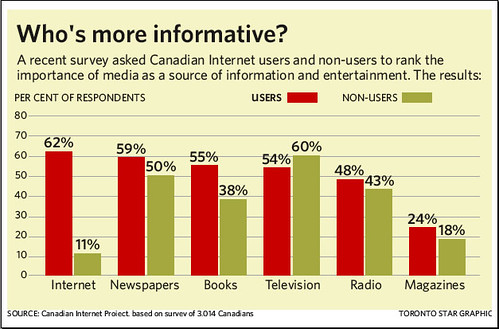
“While Internet use has a measurable displacement effect — with some time that might have been spent watching television, listening to the radio or reading magazines and newspapers instead devoted to the Internet — our data support the general conclusion that, for most users, the Internet serves more as a supplement to traditional media than a replacement,” the study concluded.

“Internet users, it would seem, are simply more media-oriented than are non-users.”

The results are based on a survey of 3,014 Canadians at least 18 years old who answered questions in a telephone interview in May and June of last year. The margin of error is 1.8 per cent, 19 times out of 20.

The study is the first to come out of the Canadian Internet Project, an ongoing research initiative led by a consortium of universities and supported with provincial, federal and private-sector funding.

Here is a chart, also from the Toronto Star, under the link “Survey Results”, comparing users with non-users.

StarNov2WebSurvey

Get the Executive Summary pdf from the Canadian Internet Project website.

tags


For Math Phobics & Math Teachers

From http://blogs.zdnet.com/emergingtech/?p=38&tag=nl.e539
Courtesy of WWWTools for Education

‘Aesthetic computing’ turns algebra into art by ZDNet‘s Roland Piquepaille — The concept of aesthetic computing can be used to teach algebra by encouraging students to express equations as pictures or stories. This approach aims to make abstract ideas or algebraic formulas look ‘real’ through drawings, sculptures or computer graphics.

Scanning & Gisting – Reading on the Web

We scan through information and catch the gist. Then, if necessary and/or interested, we can slow down and read a particular piece, or in a particular area, more deeply. Deep and/or close reading and scanning & gisting are separate, though connected skills that can be learned and practiced. The Web and the Information Age requires a broader set of reading skills, in my opinion.

George Siemen’s post, “The Joys of Shallow Thinking” in his Connectivism Blog describes it well:

What happens when we change how we interact with information? We “ramp up” our processing habits. Instead of reading, we skim. Instead of exploring and responding to each item, we try and link it to existing understanding. We move (in regards to most information we encounter) from specific to general thinking…from deep to shallow thinking. Shallow thinking, in this sense, isn’t as negative as its connotations. Shallow thinking (perhaps I need a better phrase) involves exploring many different sources of information without focusing too heavily on one source. Aggregating at this level helps us to stay informed across broad disciplines. So much of education intends to provide “deep learning”. Often, however, “shallow learning is desired” (i.e. we want to know of a concept, but we don’t have time or interest to explore it deeply). All we need at this stage is simply the understanding (awareness?) that it exists. Often, learning is simply about opening a door…

And Bloglines, or other aggregators, facilitate the process.

tags

"Participation Engenders Competence"

For an inspiring description of the impact of students writing on blogs, see Konrad Glogowski’s post in his Blog of Proximal Development.

He says –

When I think of blogs, I think primarily of what this technology enables my students to accomplish. When I look forward to reading their entries and comments I am really looking forward to thoughts made visible.

And so, when they write, I don’t want the journey to end with me as it inevitably does when the teacher is the audience. I want to be part of the collective journey. I want to lurk and see how my students develop their ideas. I want to see how conversations grow. I want to hear their voices booming through their entries. You can’t have that when you’re busy correcting spelling and fixing sentence structure.

My approach to marking has become more holistic. I’ve discovered that students who participate in communities of learners begin to care about their writerly voice. Gradually, what emerges is greater awareness of how to make that voice heard and how to effectively communicate one’s ideas. The most valuable part of this community is that this awareness emerges as a result of online interactions, of hundreds of entries, comments, and connections made online as part of a collective journey. It comes from within because the students need it to emerge. It is a practical skill that they need to keep contributing as members of the community. It is not imposed by my rubrics.

Check out the whole post.

tags


Implications of the Web for Post Secondary Institutions

From the Toronto Star, October 25, 2005
<a href=”http://www.thestar.com/NASApp/cs/ContentServer?pagename=thestar/Layout/Article_
Type1&call_pageid=971358637177&c=Article&cid=1130147342095&DPL=IvsNDS%2f7ChAX&tacodalogin
=yes”>http://www.thestar.com/NASApp/cs/ContentServer?pagename=thestar/Layout/Article_Type1
&call_pageid=971358637177&c=Article&cid=1130147342095&DPL=IvsNDS%2f7ChAX&tacodalogin=yes

You know a diploma is worth less and less. Soon it’s going to be worth nothing at all.

If you’ve just completed an undergraduate degree you might not want to hear what Mississauga-based futurist Jim Carroll has to say.

“For young people I think one of the things they will need to understand is the skill of `just-in-time’ knowledge,” says Carroll, who advises companies across North America.

He explains that “just-in-time” knowledge is the skill of learning information during quickly advancing periods of change. The information learned is entirely — and possibly only — relevant at a specific time. Learning it will require people to immediately dump previous information that is no longer relevant at the same time.

“The concept of going to school for knowledge is kind of quaint,” says Carroll, who foresees a future when longer degree programs will become almost obsolete. “What is the relevance of a three or four or five-year degree program when half of what kids learn in their first year will be obsolete by the time they graduate?”

Carroll says the majority of knowledge needed in the workplace of the future will be gained from collaborative social networks, online sources and independent learning.

As far as formal education goes, he doesn’t think many degree programs will be longer than about nine months.

“A survey I saw a couple weeks ago said young people now think self-employment is more secure than a corporate job.

“As young people continue to completely reject the concept of the traditional workplace they will also move to educational models that suit their relationship with a changing work world.”

In many ways the educational system has avoided the Web and left young people to make their own way through it. Most of them have discovered peer-to-peer file sharing for music, and some of them have discovered porn. Few know much about how to evaluate the trustworthiness of sites, or understand either the law or how easy it is to see what they’re doing on the Web.

We need to teach ourselves and all our students

  • how to apply critical thinking to what we find on the Web
  • how to research effectively on the Web
  • how to use library databases
  • how to use the Web as a learning tool/medium

My observations lead me to believe that we educators are abandonning many young people to discover the Web on their own, without our guidance, in the communication space they increasingly inhabit. Jim Carroll’s prediction will come true for sure, if we don’t join these digital natives, and share what they need to learn, while learning what they can share with us.

tags