Teaching Communication Now!

As a longtime communications teacher, I am fascinated by our changing communications media and platform. And when I’m teaching, no matter the direct subject I’m teaching, I never lose awareness of the changes our culture is going through, and the responsibility of teachers to help prepare our students for this new and rapidly evolving communications environment. They will be swimming in it for the rest of their professional and personal lives.

What is often unnoticed is that in just over a century we have gone from having one way of recording, putting marks on paper, to multiple ways of recording, all more viscerally immediate than text. Photographs, recorded sound, moving pictures all speak more directly to our senses and emotions than squiggles on paper – which our minds must translate into meaning before we can have our sense and emotional responses. It is easier to think critically when text is what we are ‘reading’ than it is when we see and hear less mediated (so to speak) representations of the world we live in. We are now living in what Ong called “secondary orality” and that is what our students have been growing up in, and to a certain extent, what we grew up in too.

I have never known a world without photographs, radio and records, movies and television. However, text was still the dominant medium, at least in my educational experiences, for most of my early schooling, and mass media ruled. I looked, listened and watched, but I could only critique; I couldn’t participate.

Now I can sit in my study and produce multimedia, as in this blog post.

Vodpod videos no longer available.

The audio is poor, but understandable, and I’m combining text with video. I can embed other sites, like what I thought about this new multimedia platform that we can access using computers –

and I can link to other sites for readers/viewers who want to explore more of the educational possibilities – http://jnthweb.pbwiki.com/

and I can make movies using my screen –
Vodpod videos no longer available.
more about “Generating a Table of Figures in Word…”, posted with vodpod

There are other tools that I can use to create a mixed media text, and, here is the point I want to make:

We need to be teaching our students (technical and non-technical) how to compose using the expanding possibilities of the web as a multimedia, participatory communication platform!

Twitter – a Brief Intro

I’ve been ‘playing’ on Twitter for a few months now. I choose who I follow based on whether we appear to have similar interests, and I let anyone who wants to follow me. There are people who I follow who don’t follow me, and people who follow me who I don’t follow back. It makes for a kind of discontinuous ‘conversation’, and you might wonder why I bother. Here are some reasons:

  • it can be interesting seeing what people are doing/thinking in different parts of the world;
  • I find links to sites about things that interest me, mostly about the impact of social media on education and small businesses;
  • I find blogs I want to add to my RSS reader;
  • reading Tweets can take the boredom out of waiting.

If you’ve heard the buzz about Twitter but don’t ‘get’ it, here are two resources that might help you start, but you have to play on Twitter for at least a month to find out how you might want to use it, and if it’s useful for you.

CommonCraft’s Twitter in Plain English by Lee LeFever

Biz Stone’s How Do You Use Twitter, on Vimeo

http://vimeo.com/1466612

The discipline of only having 140 character spaces helps you practice alternative phrasing, brevity, and, possibly, texting spellings. The availablity of Twitter on mobile devices allows you to do silly things like watch political debates while reading Tweets and writing them while the debate (or game or show) is still going on.

Personally I use a variety of Twitter applications:

  • On my laptop
    • http://twitter.com/home – the home site
    • http://www.tweetdeck.com/beta/ – which allows me to see any Replys or Direct Messages even if I’ve missed them when they first showed up on Twitter
    • There are many, many Twitter applications – use Google if you want to try some of the others.
  • On my iPhone
    • Twitterific – which is free from the App Store
    • Summizer – $2.99 from the App Store and allows you to search for topics and/or follow hashtags (Look it up;-> I had to).

So give Twitter a try, but do watch out; it can become addictive;->

udutu – Free, Easy, and Perhaps Unnecessary

udutu – The price is right, free if you don’t use their server.

udutu
udutu

It’s fairly straightforward to use –

udutu work screen
udutu work screen

You can put it up on Facebook and learners can access it there –

My course on Facebook
My "course" on Facebook

The teacher’s view above and the learners’ below –

Self Assessment
Self Assessment

I like udutu’s encouraging course creators to use the assessment tool for learners to self-assess, rather than scoring with it. It allows learners to repeat going through the materials as often as they want.

I like the ease of use with no coding, and only some figuring out needed. The small “course” I created took 2 to 3 hours and was based on a pre-existing PowerPoint, an udutu suggestion. That’s pretty quick for a first try.

I like the appearance, what the pages look like.

I have two provisos:

  1. For a highly factual content course, it might be a good fit, but for a course with a lot of student input, the kind I usually teach, it could be too prescribed.
  2. As the early WebCT did for me, udutu could provide a kind of scaffolding for teachers new to using the web in their teaching. However, having read Weinberger’s Small Pieces Loosely Joinedhttp://www.smallpieces.com/ – at an impressionable stage in my learning about the web,  I prefer to use separate applications linked to each other. For my fall course, students will be using a class wiki, which will be linked to a class community blog, which will be, of course, linked back to the wiki. Within the wiki and the blog, there will be other links
  • to web applications needed to complete the course
  • to tutorials and information about those web applications
  • to student-chosen links
  • to assignments

To me, this is the most efficient way to set up a class, and it matches the overall web culture, as I understand it. Students will be living, learning and working in that culture in their futures, so why put them in a tight framework in this part of their learning.

So udutu might work for some purposes, but not for my current ones.

MERLOT 2008, Web 2.0, Part 2

I’m home again from the MERLOT Conference in Minneapolis, Minnesota, and found it exciting for a number of reasons, especially as it was the first academic conference I’ve ever attended that had a strong focus on the importance of web 2.0 for teaching and learning. I think the MERLOT members are ahead of many other educators because they are most concerned with distance learning, and the possibilities of web 2.0 are really useful in making online courses rich and lively.

Here are some of the presentations I attended:

The 12/10 Conspiracy: Guiding Faculty and Staff Exploration of Web 2.0  as Learning Tools – Fritz Nordengren gave a highly polished performance using the 12/10  tarradiddle as an amusing shell for valuable suggestions about how to encourage exploration and adoption of web 2.0 applications to support learning and teaching. I found his reference to the PEW Typology of Information and Communication Technology Users especially helpful. I agree with him that people have individual needs and often require individual coaching, and that we are still defining what the basic technology skills are. Very enjoyable and informative.

ZSR Library Presents: Blogs & Wikis @ Wake Forest University – Susan Smith, Lauren Pressley and Kevin Gilbertson, from the MERLOT 2008 program:

Blogs and wikis are valuable communication and educational tools. These technology-enabled instruction tools can supplement or replace the traditional LMS. To provide the faculty with 21st Century educational tools, Z. Smith Reynolds Library offers locally hosted blogs and wikis for classroom use. This service supports the university’s academic mission, as well as allows the library to fulfill its mission of collecting, indexing, and preserving local content. To create a successful program, library staff integrate instructional design and technology training for faculty. This presentation will provide a program overview, explanation of the instruction, and the specifics of the open-source technology implementation.

I like their approach of hosting WordPress – http://mu.wordpress.org/ and MediaWiki http://www.mediawiki.org/wiki/MediaWiki installations on their server for multiple accounts. WordPress is a highly regarded free blogging application; I use the WordPress.com account myself, while theirs is the WprdPress.org version. MediaWiki is the wiki used for Wikipedia; I prefer wiki applications that are totally WYSIWYG while MediaWiki requires some wiki coding. Intelligent and interesting presentation.
Talking with Technology: Asynchronous, Synchronous Communication and Beyond Using Free Software – Takako Shigehisa. Of special interest to teachers and learners of languages. In this excellent presentation, the following applications were introduced: Audacity, which I use in my own Oral Communications course, Photostory3, SkypePowergramo, and Chinswing, plus Gizmo ProjectVoiceThreads and iVisit – A rich selection of very useful teaching/learning tools.
Facebook and Podcasting: Convergence for Freshmen – Peter Juvinall suggests going where the students already are:

Facebook provides a unique opportunity for educators in that it enables a convergence of communication technology. This presentation will cover the benefits of using Facebook as a classroom management solution, the lessons learned from a freshman-level class, and a proper approach to using it in a classroom environment in conjunction with podcasting and traditional means of classroom communication.

Interesting approach, although I’m not sure I’d want all my students on my Facebook account, and not sure they would want me on theirs. Juvinall, however, makes sophisticated use of Facebook Groups and other possibilities. Very interesting and student-oriented approach.
eLearning Strategic MERLOT – Robbie Melton is an amazingly skilled speaker, and I found her strategies fascinating and practical. As the chief academic officer for the 5th largest system of education in the USA, with a 29% increase in online learning this year, she has her institution use MERLOT as an integral part of faculty development. As a teacher of rhetoric, I was deeply impressed by her speaking skills, and personally envious. As a teacher educator, I admired her sensible approach for involving both teachers and students using MERLOT.
Wikis and the Pressure of Public Writing – Dorothy Fuller case study on having groups do collaborative research and writing using wikis was very valuable. Her description of how inhibited people are when editing other people’s text, matched my own reactions to using wikis. This is an important aspect to using wikis for collaboration; we, as a culture, have to learn the ‘skill’ of sharing writing tasks in a public space. An informative piece of research.
Web2.0, the Social Media and Academia: Using Personal Learning Environments to Expand Teaching and Learning – my presentation – described by blogger Lauren Pressley http://laurenpressley.com/library/?p=623 She kindly didn’t mention the technical snafu when the Hotel Hilton’s irritatingly weak wireless system caused my computer to crash, leaving me to talk through the last third instead of showing. My PowerPoint can be found on SlideShare here – http://www.slideshare.net/vinall/merlot2008-vinall-cox-j-presentation

So I learned a lot at MERLOT – check out the richness of the program if you like, – http://conference.merlot.org/2008/Program2008.html – and I met people interested in the web applications I find both useful and fascinating for teaching and learning. Some people I will encounter again on the social network based on Ning called MERLOT Voices – http://voices.merlot.org/
I recommend MERLOT membership –  http://www.merlot.org/merlot/index.htm

MERLOT 2008 – Web 2.0

MERLOT (Multimedia Educational Resource for Learning and Online Teaching) is an interesting organization, made up of people from a variety of disciplines, focused largely on distance learning. It is the first academic conference I have attended with a strong focus on the use of Web 2.0 in teaching – something I’ve been looking for.

So I’m here in Minneapolis, where I admired the architecture Wednesday, and I’ve been attending sessions since then. Darcy Hardy was a good and interesting speaker yesterday morning, talking about online education, leadership, and success. She shifted my attitude on distance education and online learning.

The session, MERLOT Introduces Web 2.0 Friday morning, demonstrated the new MERLOT social network, set up on Ning, called MERLOT Voices.

This should give members a place to play with/in a social site and connect with others of similar interests. MERLOT Voices combined with the resources of the original MERLOT website, gives teachers access to a huge repository of teaching resources.

In No More Traditional Classes, Dr. Dan Lim looked into a future where iPhones would be part of mobile learning, and game-based education would be far more common. Michael Scheuerman, in Report on a Longitudinal Study – comparing synchronous and asynchronous elements in online courses, came to the interesting conclusion that synchronous elements required less faculty time than asynchronous.

Neil Griffin described a number of examples of free software available to teachers (or anybody). He mentioned exe for learning packages, Match-up for quizzes, Audacity for audio recording, Media Coder for converting file formats, –  and others.

Saturday started with a plenary with Bernie Dodge, the originator of WebQuests, speaking on “What Would Dewey Do?” His thesis was that technology is where our society, and our students, live now, and what they need to learn about experientially. As I’ve used the concept of WebQuests since the late ’90s, I was delighted to meet him in person. What he had to say about the Web 2.0 environment and teaching and learning matched my views. I, too, see wikis and podcasts as very useful learning tools, and VoiceThreads, but, like Dodge, am not sure of Second Life which seems to demand too much energy for the technical details, leaving not enough for the content.

I’ve attended Web 2.0: What is it and why Use it? which was a good basic introduction and VR3 – Virtual Reality: Vehicle for Recruitment and Retention describing East Carolina’s experience of having a virtual campus and classes in Second Life, another introductory taste of a tool.

So far, I’m having an interesting and educational time. As often happens at a conference, my informal conversations are among my richest learning events, whether I’m talking to young web, learning and graphic designers in a Japanese steakhouse, vendor reps at lunch, or other teachers at coffee breaks.

I’m looking forward to the rest of the conference.

MERLOT Presentation on PLEs

I head out tomorrow for the MERLOT International Conference in Minneapolis, Minnesoda where I will be presenting on Web2.0, the Social Media, and Academia: Using Personal Learning Environments to Expand Teaching and Learning.  (The description is second from the bottom here.) I am asking for some help in proving my point – that creating your own Personal Learning Environment is essential for teachers and other knowledge workers.

I’ve worked up a PowerPoint with many links to many free applications and images of what a PLE actually is, but I want to show its value during the presentation. I received  some important help in my learning from  comments when I posted on Visual Literacy here, I’ve received help from responses to some of my Twitter postings, as you can see here, and someone (sorry, I can’t remember who) pointed me to http://aquaculturepda.edublogs.org/2008/07/19/listen-to-the-wisdom-of-your-network/ – which has really inspired me. I really like Sue Water’s use of the phrase “Personal Learning Networks”, and I’m imitating some of her approaches, and this is where you come in.

Please help me show the power of Personal Learning Networks by responding to some or all of the following requests:

  • Add a comment to this post mentioning any part of your own PLE that other teachers might find valuable;
  • If you are on Twitter, follow me, and when I ask for responses, use “Reply” so I can show how the network can help almost instantly; and/or
  • If you have some ideas that might help, “Direct Message” me in Twitter.

I’m presenting Sunday, August 10 at 11:45, Central Daylight Time – an hour ahead of Eastern Daylight Time. (It’s 8:30 near Toronto, and 7:30 there.)

So I’m requesting your help, and, in return, I will post some version of my presentation after the conference is over and I’m home again. So thanks in advance.

MERLOT Member Page
MERLOT Member Page

Chunkit and Cuil

In the past few days I’ve been alerted to two new search tools. A friend, knowing my web-fascination, sent me a link to Cuil – http://www.cuil.com/info/ – I have only briefly played with it, but the information has hit the Twitterverse, and it was created by Google alumni, so you might want to check it out.

Searching for Vygotsky

The other search tool I found out about from a comment from someone called Sasha on my blog. Chunkit is still in beta, you have to add a small download – Windows, Mac & Linux, IE 6.0+ or Firefox 2.0+ – but I found the Chunkit videos and information intriguing enough to download the application.

Searching for Vygotsky 2

When you click on the most interesting text on the left, you are taken to the source site with the relevant text highlighted:

Source site
Source site

This looks like a handy research tool to me. I found the videos helped me learn how to use Chunkit, including the Search Options –

Chunkit Search
Chunkit Search

I have 3 small criticisms, less to more important:

  • the colours, orange and black are Hallowe’en colours – ugly;
  • The toolbar takes up a chunk of my small laptop screen; and
  • the education-oriented videos are all oriented toward the partying, last-minute essay writing, and one almost suggests plagiarism – inappropriate.

However, some of the videos have pages attached, like this one on Gutenberg for those who want a static set of instructions. The abudance of videos for many purposes, household, shopping, news, academics, and business, make it easy for the viewer to dip into the different uses he or she might make of Chunkit. After sampling a few, I found it easy to navigate Chunkit, and to use it for my purposes.

Chunkit PLE
Chunkit PLE

So what do you think? Are either of these a helpful addition to your searching? One more than the other? I interested in how others see them.

Jing (for Screencasting) and TweetDeck (for Twitter)

Summertime is playtime, and we’ve had record amounts of rain where I live, so my playing has been indoors. Here are a couple of tools I’ve been playing with.

Jing is a free and very easy screencasting tool. Because I’m thinking about Personal Learning Environments, that’s what I made this screencast on –

http://www.screencast.com/users/JoanVinallCox/folders/MERLOT/media/15cb112a-af72-4d8a-a7c0-f41d42041696

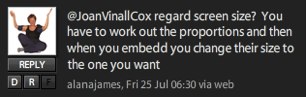
My problem is that by covering my full screen, I get a screencast the size of my full screen, which is too big. Twitter helped me get a partial answer. (I’m using TweetDeck because with it, I can see any replies immediately and I can separate the people I follow into different groups, for ease of following conversations.)

From TweetDeck, Alana James answers my request for help.

Alana’s advice allowed me to reduce the size of my Jing screen, but it only showed part of what I had captured. I wanted the whole image, but smaller. I have asked for help on Twitter several times previously and most often got a reply, so I consider it an important part of my PLE. It’s a place where I can ask and answer questions from peers.

So I’m playing, and thus learning how to use these tools, so when the weather is sunnier and/or I’m busier, I’ll be proficient and efficient in using them.