You are who you are
because of
and despite
your mother.
You are who you are
because of
life’s surprises
and how you felt them.
You are who you are
because of
what you have grasped
and avoided.
You are who you are.
Figuring Out Life While Aging
You are who you are
because of
and despite
your mother.
You are who you are
because of
life’s surprises
and how you felt them.
You are who you are
because of
what you have grasped
and avoided.
You are who you are.
I’ve just read a very interesting post on a version of dyslexia that deals with numbers – http://www.bdadyslexia.org.uk/about-dyslexia/schools-colleges-and-universities/dyscalculia.html and now I understand a lot more about how my mind works, and doesn’t work.
I have trouble with left and right, and trying to read maps is painful and embarrassing. I also switch numbers (1,2,4,3,5 etc.) if I try to read them quickly. I have to be VERY careful with large numbers as I can confuse 1000 with 10,000, etc. Plus it’s very hard for me to remember telephone and other numbers, even dates in history. So I think I have dyscalculia. I am also mildly dyslexic, and have some trouble with spelling, but I love words and writing. Despite those limitations, or maybe because of them, I’ve been told repeatedly that I’m a good teacher, good at helping people learn.
I am deeply grateful that I was able to learn and develop tactics that allowed me to survive and thrive as a student and as a teacher. Both as a teacher and as a learner I have observed that people often don’t remember how they learned something; we just own and use what we’ve learned and move on. So I can’t remember how and from whom I learned my tactics for surviving my weaknesses by adapting my strengths to cover for them. The only way I can express my gratitude is to show others alternate learning and performing routes that might work for them. And share with everybody what I learn about how our human minds work, and how differences in how they work can be dealt with compassionately.
Giving people the space and opportunity to learn how they learn, and how they can deal with their weakness as well as their strengths is not only wise and kind, it creates a better world for all of us.
If you are reading this and think you might be dyscalculic, check out your sense of self-worth and see if you have learned to focus on adaptations to help you survive, or if you dwell too much on what you struggle with. Perhaps you need to acknowledge how hard you work, as much as what you can’t do easily. To boast and inspire, I eventually got my Ph.D. and posted my thesis on line – http://www.scribd.com/mobile/doc/2063617 and here’s my not quite up-to-date e-portfolio – https://joanvinallcox.wordpress.com/my-e-portfolio/
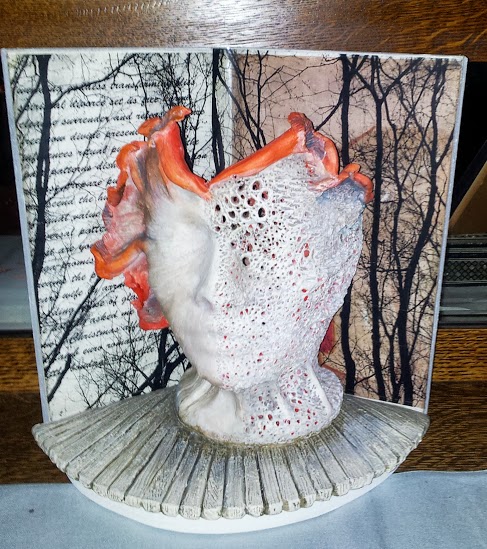
Spent some happy time today wandering through the Hamilton Art Crawl. As they say there, “Art is the new steel”. I was really impressed with all the activity, food, music, and, especially the art. I haven’t bought any art for ages (unless you count unusual jewelry ;->) but I couldn’t resist the piece above, by Leslie Furness. Check out the Crawl next month – it’s really something!
Holiday Monday and I’m playing on the web. I’m scanning through my MakeUseOf.com subscription and decide to look at this – http://www.makeuseof.com/tag/technology-explained-how-the-internet-works/
I read this:
Look at a map of the Internet sometime and you’ll see that it is like a million superhighways with no lines painted on the road. It’s a snake pit of computers attaching to modems attaching to phone lines, or cable, or satellites, or cell networks, attaching to more computers, servers, routers and modems and so on, and so on. There is no beginning. There is no end.

In the image above, you are looking at one very small part of the Internet. See that star-burst like image it is extracted from? Go take a look at the full image.


The web is made up of connections, and that’s how our minds work to: the visualization of the web looks like a dandelion, and knowing the global nature of the dandelion, I can grok the global outreaching of web connections.
The web is made up of almost infinite connections, and when I land on one, my mind makes the connections that seed my use of the web’s connections. I link on/with the web.

We can see more people creating more works than ever before in history. And it’s because of the web and because the web is social. On the web, much is possible. Whether you are finding the right beautiful photo (with the right Creative Commons license) to illustrate metaphorically the connectivity and the beauty of the internet for a blog post, or whether you are playing with a web app (Skitch – http://skitch.com/) to draw


So serious people who sell cars and race cars become part of the crowd playing:
Two typographers ( Pierre & Damien / plmd.me ) and a pro race pilot (Stef van Campenhoudt) collaborated to design a font with a car.
The car movements were tracked using a custom software, designed by interactive artist Zachary Lieberman. ( openframeworks.cc )

The YouTube video, The Pirate’s Dilemma, looks at the cultural problem of our creativity being largely bricolagic, (if that’s a word). We see other’s doing something and we imitate and/or adapt it. We follow trends, and we build on other’s ideas. But people need to make livings, and creators should get credit and rewards. Yet we humans like to play with ‘stuff’. Where does the label “piracy” stifle innovation, and where is it accurately describing a rip-off? This is the question that motivates people on both side of the Canadian C-61 debate, and the world-wide copyright and intellectual property debates.
via Chris Brogan
Where do you stand?
 Learning Living
