Dreaming The Curriculum – A Re-Post from 2006

With the rapidly changing web environment, much writing is ephemeral, and becomes lost in the past. This is a post I think worth re-posting, about the process of creating curriculum. Most of the links no longer work.

From 2006 –

Dreaming the Curriculum: Oral Rhetoric

This past winter term, I taught a course, Oral Rhetoric, a third-year university course, for the second time. The first time, I taught it using two-hour classroom meetings, once a week for the term. The second time I taught Oral Rhetoric, I used Web-tools to supplement the classroom time. This is the story of the impact of a community blog on Elgg, a course wiki on Wikispaces, and the audio-editing freeware, Audacity on this course. This is a story about Web 2.0, the Social Web, and learning.

My story begins, sort of, with my initially agreeing to teach Oral Rhetoric. The name caught my imagination, because, as an English teacher, I had studied “oracy”– the practice and impact of speaking, – and I liked teaching people how to speak well and powerfully. I taught both theory and practice to the students in the first iteration of this course. Most of them learned more about how to speak, a little linguistics, and some theory about language and speaking. But when I planned to teach Oral Rhetoric a second time, I began to dream up some changes. (I rarely teach exactly the some material exactly the same way twice, because I learn something from each class, and I am constantly learning more about communicating.)

Another beginning to this story is tangled up in my belief in teaching from the past and into the future. When I planned the most recent iteration of this course, it was 2005, the year that the word, “podcast” was declared Word of the Year. The Web, and Web 2.0 in particular, had implications, I believed, for oral rhetoric, as did Aristotle’s work, Walter Ong’s theories about “secondary orality”, Deborah Tannen’s research on linguistics, Marshall McLuhan’s concepts about the impacts of the media, and, of course, the digital generation’s facility with the online world. I resolved to use the communication tools that are evolving in our culture as part of this course, because that would support an understanding of the craft of speaking (and communicating) as it is developing online today.

I would teach cultural roots and, using theory and practice (which includes technology), create a learning environment where students could build a foundational understanding that would allow them to extend and develop their learning into the future. My ambition was to have students understand the power of communicating using the physical voice in a variety of modes, from face-to face to media-delivered situations. I wanted them, in our media-saturated environment, to understand how media alters the impact of individual voice communications.

I decided to focus on storytelling, formal presentations, a requirement to be filmed, so they could see and hear themselves speaking, and the creation of an audio file (an mp3) of their story to be posted online. I wanted them to understand, as speakers and listeners, on a visceral as well as a theoretical level, how the physical voice communicates. My research evolved out of what I was already studying: Aristotle, Havelock, Ong, Farb (Word Play) Tannen, McLuhan, and, of course, Web 2.0. (I had been building my knowledge in these areas for years, using fascination, work assignments and graduate studies.)

As I began developing my upcoming iteration of Oral Rhetoric, I, almost accidentally, set up a situation that came to inspire me to take early retirement. When I was presented with a fulltime work assignment that was uninspiring and unattractive to me, an assignment that might interfere with teaching this part-time course the way I wanted to, the way I believed was most valuable to the students, I baulked. After a brief review of my situation, I decided to leave my long-term fulltime employment, and focus on this part-time teaching, some tutoring, and consulting on educational uses of Web 2.0.

My focus on planning Oral Rhetoric intensified. I am an elder in the field of education, both in terms of my hands-on experience and my studies. I have been teaching for the great majority of my working life, over 35 years. During that time I have studied, both formally and informally, how people learn to write, read, and communicate. I have also studied, both theoretically and through my teaching practice, how people learn. I know a lot about pedagogy (or androgogy) and curriculum theory, but I don’t think and plan using theories directly, except sometimes as final checklists after planning. As a teacher, I intuit, I use my tacit (Polanyi) know-how about what will help people learn. I have learned the theory, and use it, but I don’t label what I’m doing with it. (For me, planning is like dancing, and, in dancing, if you think directly about the moves, you become clumsy.) At this stage in my career, I design and plan by imagining, by almost feeling how something will work for learning. I get indistinct ‘senses’ of what is possible and develop them by talking and/or writing about how and what I want to teach.

While planning Oral Rhetoric, I talked to my husband, Jim Cox, also a career teacher. Our rich conversation has extended years as we discuss, in phenomenological detail, with conceptual overviews, how we humans perceive and learn. I also discussed my ideas with Guy Allen, the head of Professional Writing and Communications at the University of Toronto in Mississauga, the program hosting Oral Rhetoric. (I had read Guy’s work on how people learn language developmentally (Allen, 2002) and audited him teaching the required introductory course and I was delighted to be teaching in a program with a pedagogy that matched my experiences and understanding of how people learn language.) In particular, Guy’s suggestion of using the CBC program, Outfront, became central to my thinking about Oral Rhetoric.

The other place where I got help was online, both in my ongoing survey of the blogosphere, focussed on education and technology, and through my Elgg blog. I searched and read about podcasting wherever I could, but found it technologically intimidating. Although I have taught myself enough html to be able to add bits to my blog sidebars, and copy and paste RSS feeds into my Bloglines account, I am not from a technical background; I am from a communications background. I knew about Audioblogger, and had played with it, but I wanted something more sophisticated. Somewhere online, I read about Audacity, a free, downloadable application for recording and editing sound. It had very positive reviews, so I downloaded it and began playing with it.

My husband had taught audio, and although he wasn’t familiar with Audacity, it resembled other (more sophisticated) audio recording and editing applications enough that, between him and the online tutorials, I created my very own mp3 of myself lecturing. Somehow, I can’t remember clearly how, I realized that I could use Elgg blogs to post mp3s, and you can see and hear the result here – a rather dry recording. When I listen to it after hearing the work my students did, I would give my recording a ‘D’. But what was central was that if I, a non-technical “digital immigrant” could create and post an mp3, I reasoned that my students, “digital natives”, could surely do the same. And if any of them couldn’t, for sure they would be able to use a phone, which is all that is required for Audioblogger. I explored the Elgg site a little more and discovered “Community blogs”– where I could set up my class so all the members could post in the same blog, and add their mp3 assignments.

I needed one more technical component. With blogs, postings are chronological with the most recent at the top. With wikis, pages look like a regular Web site, but you can create and edit them online, without using html or ftp. I had used a wiki application in a previous course, JotSpot, when it was in beta (or development) and free. It was visually attractive, and as easy as using a simple word processor, but no longer completely free. (Free Web applications are handy because students can download them on their own computers, and because teachers don’t have to ask for funding, i.e. permission.) After some exploring, I found Wikispaces, which was free, if you accepted the ads along the side, and WYSIWYG (“What you see is what you get”) meaning little technical learning was needed. So I had the technology and some of the ideas lined up, but I needed more thinking. So I wrote in my personal Elgg blog, imagining students as my audience  I found the feedback both affirming and helpful. It was time, and I was ready, to open a calendar and a calculator and begin the onerous task of planning what assignments, worth how much, and when due. The dreaming was mostly (but never completely) past and the intensive planning was next.

I will post on those specifics in a few days.

Works CitedAllen, G. (2002). “The ‘Good Enough’ Teacher and the Authentic Student”. In J. Mills (Ed.), A Pedagogy of Becoming (pp. 141 – 176). NYC: Rodopi.
 

How to Target a New Tab for an Image Link

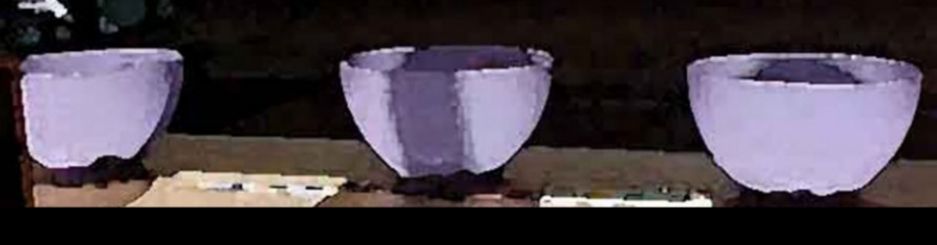
Here’s a picture I want to link to another website and have it open in another tab or window:

joanvinallcox.ca

The image above links to the website it’s from, but opens on the same page as this post, replacing this post.

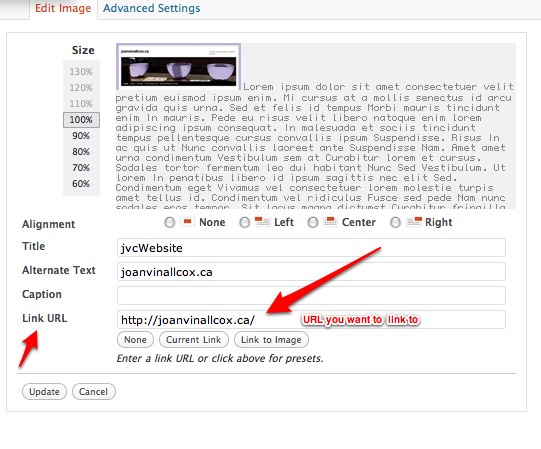
I click on the image (in Edit) and choose the far left icon of a picture, and check that the link I want to target is there:

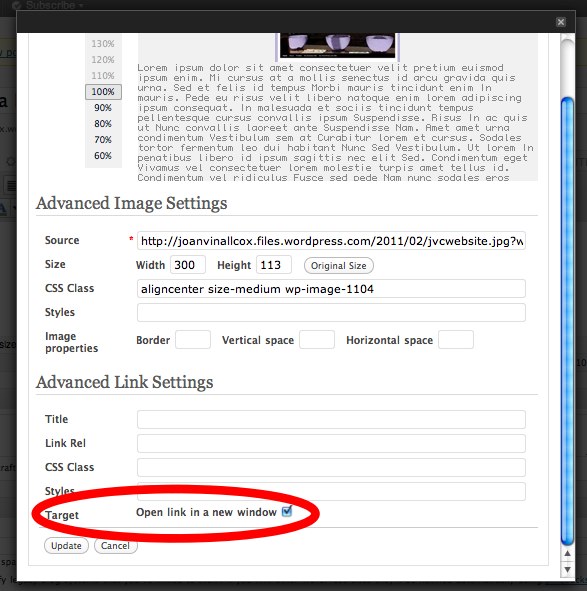
Then I click on “Advanced Setting at the top, and scroll to the bottom of the next screen

Click beside “Target, and now, your link will open in a new tab or window:

joanvinallcox.ca

2010 in review

The stats helper monkeys at WordPress.com mulled over how this blog did in 2010, and here’s a high level summary of its overall blog health:

Healthy blog!

The Blog-Health-o-Meter™ reads Fresher than ever.

Crunchy numbers

Featured image

A helper monkey made this abstract painting, inspired by your stats.

A Boeing 747-400 passenger jet can hold 416 passengers. This blog was viewed about 5,400 times in 2010. That’s about 13 full 747s.


In 2010, there were 62 new posts, growing the total archive of this blog to 548 posts. There were 48 pictures uploaded, taking up a total of 10mb. That’s about 4 pictures per month.

The busiest day of the year was March 31st with 57 views. The most popular post that day was Kluging: An LMS Alternative.

Where did they come from?

The top referring sites in 2010 were teacher.pageflakes.com, c4lpt.co.uk, twitter.com, ianmason.net, and browse.workliteracy.com.

Some visitors came searching, mostly for visual literacy, fotobook editor, udutu, google cheat sheet 2010, and google search cheat sheet.

Attractions in 2010

These are the posts and pages that got the most views in 2010.

1

Kluging: An LMS Alternative October 2008
11 comments

2

Visual Literacy and Visual Thinking July 2008
10 comments

3

Joan Vinall-Cox’s E-Portfolio September 2008
20 comments

4

Photobook Adventures (and advice) December 2008
4 comments

5

udutu – Free, Easy, and Perhaps Unnecessary August 2008
2 comments

Second Last Class – Seeing Early Results

I’ve been teaching a course called Oral Rhetoric, a course where I work with students on their public speaking, both in face-to-face situations and in creating online audio recordings. Yesterday was the second last class and we spent most of the class time listening to their second last assignment, a commercial/pitch to advertise their final assignment – a story of theirs that they create a recording of and post online. The recordings of their pitches we heard were wonderful, and why wouldn’t they be. These students have spent all their lives listening to radio and tv commercials. They might not have Gladwell’s 10,000 hours of commercial-listening to gain expertise, but they do have hours and hours of soaking in just how persuasion works.

Over the term, I asked them to read about and practice two kinds of rhetorical skills:

Both the traditional and the current forms of rhetoric were in evidence in the pitches we listened to, but what really thrilled me were the spontaneous responses. We’re using PBWorks for our course container and it allows comments on pages. At the bottom of the Pitch page, was a conversation, a series of comments praising many of the pitches. I was thrilled because I had been trying to develop a Community of Practice approach in the course. After almost every presentation or posting of student work, I asked students to describe their own experiences while doing their own presentation/recording and to give positive feedback to at least three of their classmates. This was an assignment and posted on a weekly Discussions page on the course wiki. I wanted them to learn from each other, and to get used to learning from colleagues as a way to continue learning in their futures. The responses in the Comments section of the Pitch page were an unrequired, spontaneous manifestation of giving each other feedback. What that says to me is that some of the students have developed the habit of responding, and could recognize the technical possibilities (the Comment space at the bottom of the page) for sharing those responses. They have both the communication and the digital know-how.

Makes me happy

Joan Vinall-Cox, PhD (905)
JNthWEB Consulting – http://jnthweb.ca/
Social Media & Learning

Posted via email from joanvinallcox’s posterous

My therapist – Twitter

When I started on Twitter, in January 2008, I added many ‘friends’ I was already following in other social media, and some of my fellow freelancers from the Halton-Peel Communicators Association. My social media friends I had discovered from blogging on Elgg (now Eduspaces), a network aimed at academics studying education and learning. I browsed blogs in Elgg and found people to follow. I loved the social quality and having ‘friends’ online. Anyone who followed me, I followed back, ’cause that was the custom and the polite thing to do. And I tried to read all their blogs (and felt inadequate when I got behind). Despite knowing how to scan and skip when reading other blogs, I felt these people were my friends and I had a social responsibility.

When I joined Twitter in January 2008, I initially followed the same practice. It was actually a relief because I allowed myself to follow fewer blogs, and just keep up in micro-blogging. In the morning, I would go to Twitter and search back to the last post I’d read before going to bed the night before, then I dutifully read up to the current posts, if I had time. Every time I had a break, I went to Twitter (less fattening than a blueberry muffin) and tried to catch up.

It was onerous, especially as I kept following back the people who followed me. I began to compromise. I only read posts that had links. I chose favorites among those I was following and set them up in their own group, so I could follow the condensed version. I noticed that some of the people I chose to follow, didn’t follow me back. I commented in presentations on the asymmetrical structure of Twitter, as opposed to the reciprocal structure of Facebook. Yet every time I got the email announcing someone was following me, I clicked on the Twitter link but I began getting hesitant about following back.

I looked at their most recent tweets, and if they didn’t really interest me, or looked like pushy sales stuff, I began not to follow back. Some just looked like they were exploring, and I didn’t want to hurt their feelings, but I couldn’t see the benefit from following them. So I didn’t. The ones I regarded as sales broadcasters I began to enjoy not following. I felt assertive. I felt like I had boundaries. (Yes, I read a lot of those self-help books ;-> ) I felt strong refusing them.

One day I clicked on the link of someone new following me and looked at the posts, and then looked closely at the avatar. Both were obscene. I’d noticed that there was a link labelled “Block”; I used it. I didn’t want to appear on “her” list of followers. (I’m not sure it was a female; these things can be faked.)

If this is obvious behavior to you, it wasn’t natural for me, an older, Canadian female. But Twitter led me step-by-step into deciding who I want to follow and who I want to totally block. It was gradual, and great. Outside of Twitter, I have begun to openly say “no” when I want to. I’m polite if they are and the context allows it. When someone recently asked to do a guest post on my blog, I looked at her work and was impressed, but realized I didn’t really know her, and I didn’t want to share. So I emailed my unwillingness. I did the same thing when a company asked to place something on my blog. I was complimented, but I didn’t want to include. it. Both people thanked me for my response. (I think many people just ignore them, but their approaches were polite, so I responded in kind.)

In this way, weird as it seems, Twitter has been like a therapist for me; I have learned I don’t have to follow back and I can block rude and pushy followers. And I like that!

http://jnthweb.ca/
https://joanvinallcox.wordpress.com/my-e-portfolio/

Posted via email from joanvinallcox’s posterous

The Web is a Creativity Generator generating a Culture of Creativity

Photo by Tabea Dibou, from Flickr

We can see more people creating more works than ever before in history. And it’s because of the web and because the web is social. On the web, much is possible. Whether you are finding the right beautiful photo (with the right Creative Commons license) to illustrate metaphorically the connectivity and the beauty of the internet for a blog post, or whether you are playing with a web app (Skitch –  http://skitch.com/) to draw

or to explain something

The web is a space where people want to make, to create. I’m creating this blog post, because it’s FUN! And easy. The phrase “user-friendly” developed with the personal computer. Web apps are aimed at being user-friendly to entice and encourage people to use them, to be creative.The social aspect of the web, the possibility of being seen/heard/recognized, even if only by a very few others, encourages people’s creativity. I might not have composed this blog post if the one I created yesterday hadn’t been re-tweeted, and got  a comment. That thrill of recognition is energizing. So people are playing on computers and posting their creativity on the web. As we get responses ourselves, and even if we just see others get responses, we are encouraged to join in the play. And playfulness spreads.

So serious people who sell cars and race cars become part of the crowd playing:

Two typographers ( Pierre & Damien / plmd.me ) and a pro race pilot (Stef van Campenhoudt) collaborated to design a font with a car.
The car movements were tracked using a custom software, designed by interactive artist Zachary Lieberman. ( openframeworks.cc )
Which I downloaded – nl.toyota.be/iqfont and played with.

Art, play, creativity – that’s how we humans learn and that’s what makes us happy and healthy. And the web is our creativity playground.

Posted via email from joanvinallcox’s posterous

Why I Use More than One Social Bookmarking Service

Not that I’m paranoid (or maybe I am but I like to call it cautious skepticism) but I am always aware than any of the free web services that I use, or even ones I’ve paid for, could go belly up and my stuff on it (them) could vanish into a black hole. So when I read about speculation that my wonderful collection of bookmarks on del.icio.us could disappear, I feel my paranoia is justified.

Internet search marketers could lose some invaluable free tools from Yahoo such as their Site Explorer. Marshall Kirkpatrick at ReadWriteWeb was concerned what the deal meant for Build Your Own Search Service (BOSS), Yahoo’s search developer platform Search Monkey and social bookmarking service Delicious, which he described as “one of the last era’s most heartbreaking symbols of untapped potential in social media”.

Bing is exciting as an effective challenger to Google, but if that competition comes at the cost of cannibalising Yahoo’s innovative search work – then we won’t be so excited about Bing any more.

I also celebrate that I have a strategy to deal with this. What are the odds that two similar web services will disappear at the same time? Not good, I hope.

My web stuff paranoia has led me to set up another social bookmarking service called Diigo. So I have two active accounts on different social bookmarking services.

So does that mean I have to save everything I like twice? Well, sort of, but that’s because I’ve recently taken to using Evernote, a broader and more visual saving application. But back to strictly social bookmarking. I only save once.

How? you ask. In Diigo, under my account name, I go into “Tools” where I can “Import Bookmarks”, but more importantly, I can “Save Elsewhere”. I have added my del.icio.us account here, and every time I save to Diigo, I also save, without any extra work, to del.icio.us.

So I’m prepared! If Yahoo and Microsoft let del.icio.us die, I still have all my bookmarks in Diigo. (Same thing if something happened to Diigo.) And I have Evernote too!

Posted via web from joanvinallcox’s posterous

The Web is a Bottomless Toy Chest

I like to play on the web, and my biggest problem is my “I-can’t-catch-up” anxiety. There is always more to explore. And for free, either for the basic version or for a month. I can never try everything out. I can’t catch up. Ever.

I make things even more intense by following people who suggest really interesting web toys. Like Jane Hart, with her Jane’s E-Learning tip of the Day

If you teach or train, or just like to play on the web, you should check out her blog, and subscribe to it.Another of my current people to follow ’cause they give really neat toys – whoops, I mean URLs – away, is Steve Rubel – http://www.steverubel.com/ – Twice he mentioned Posterous. The first time, I tried it but left it orphaned. The second time, months, maybe years, later, I found my original account and started playing, even sort-of lifestreaming, copying him. Great fun.

His constant exploration and evolution is inspiring. Check him out, and subscribe to him in Posterous, and maybe to me too;-> As they say on tv, “Time well wasted!”

Posted via email from joanvinallcox’s posterous

Reading Content; Content Reading

All learning is contextual, in my opinion. You have to already know some aspect in order to learn more. I remember my Psych 101 prof, many, many years ago, saying that any book with more than 10% new content would be unreadable. So this video, found through krea_frobro747 on Twitter, appeals to me because it makes sense of my experience both as a reader and as a teacher of reading. Anyone concerned children learning to read, here’s foundational knowledge. (Might help mild dyslexics, too.)

In fact, when I roam the web trying to learn, I have problem trying to understand posts where I can’t bridge the gaps because I’m missing crucial knowledge. I guess the real take-away from this video is the more content you know, the more texts that are accessible to you, and the more you can teach yourself.

It’s like watching (or reading) the news. Initially it’s all disjointed and confusing. But watch and read long enough, and you pick up what you need to know to understand it. You see the patterns; you learn more faster. That’s why experience is valuable; your knowledge net is large and finely detailed.