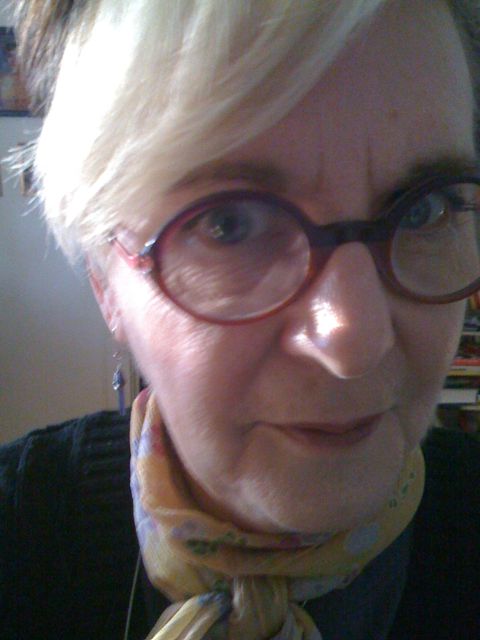
Joan Vinall-Cox, Ph.D. is a lifelong learner, retired communications professor, rabid reader and poet who has taught in both the college and university systems.
Her Ph.D., in 2004 was an Autoethnographic Arts-Based Narrative Inquiry focused on moving from technophobia to technophilia.
She is a widow from a happy marriage and a mother to a strong and kind daughter.
Her interests include Centering Prayer, Multiple Intelligences, Attention Deficit Disorder and its connection to creativity, Jung, Campbell’s Monomyth, and Arts-Based Narrative Inquiry
An autodidact is someone who learns outside of regular school settings, someone who teaches herself (or himself). It used to be a kind of demeaning label, meaning someone who had spotty and uncertified knowledge. I claim the label “autodidact” as a badge of honour! I used to learn from books, even sometimes from tv, but now we have the web. I love the web. I learn so much from what I find on it.
Recently I gave myself a task that requires me to learn more about how to create web pages. I’d heard about CSS and knew, theoretically, what it could do. But every time I tried to do anything using it I hit THE GAP. THE GAP is the point where I get stuck and can’t go any further, even though I can see what I could do two steps along the learning path I’m on. When I hit THE GAP, I’m stuck. What I do then, is ask a knowledgable friend, if I can find one, or, more often, find a workaround. For a while, my workaround was wikis. I love wikis but they’re meant for sharing, not for using as your personal website, although they can work, sort of, as one.
One of My Wikis
Sometimes I find something a lot of the design work has been done for me, and I use that. Blogger had templates, and so does WordPress, which I graduated to.
My Blog
But my design vision just isn’t satisfied.
I used tools like the old Netscape Composer and currently its grandchild, Nvu, both of which are WYSIWYG web page creators.
My Domain
But my reach exceeds my grasp because I want something I have more control over. I want to produce the kind of website that says to readers “this person has powerful content: you can tell by the appearance!” (I’ve read the research on how people are reading before they decode a single word. The appearance of the text and page gives information that signals information to readers which profoundly affects how they take in the content.)
I’ve learned a little HTML code, and I’ve bookmarked sites where I can find more. But I’ve never taken a course in it, and a lot of it just looked bizarre and unreadable to me. (I was a text person initially, and not technically inclined, but I want to communicate on the web so I have to learn how to do so wholistically.) And using “View Source” and copy/paste seemed to me like a kind of plaigarism and theft. (What can I say? I’m old-school.)
Sometimes I think I learn backwards. I know my desired destination but I keep getting blocked at THE GAP. But I continue to struggle to build a little further out into the unknown territory, and I learn something from each struggle. Each struggle closes THE GAP a little more. I read manuals and follow instructions but I think most people who are inside the knowledge bubble have trouble being aware of what those outside the bubble might not know. The instructions are crisp and clear until they mention going to the “terminal shell” or some other ‘obvious’ term. Huh? Wikipedia tells me what it is, but I don’t get how to use it in this set of instructions. (I’m not the knowledgable audience they were writing for.) So I stop and try some other path. Till I get frustrated with it, because I’ve foundTHE GAP in it. I’m really good at findingTHE GAP. So when I find someone, often on the web, who explains things in a way I can understand, someone who gives me the practical aspects of the concept, I am delighted, excited and grateful.
That happened to me today. I found Chris Coyier’s video on HTML & CSS – The VERY Basics. 32 minutes of pure pleasure. He shrank –the gap – till it virtually (no pun etc.) disappeared for me.
He has a gift for teaching and I’m a grateful student.
Clay Shirky, in Here Comes Everybody says “for a hundred years after, the printing press broke more things than it fixed” (pg. 73).
We are watching parallel occurrences currently. CBC’s Sunday Report broadcast this excellent informative description of what is happening to newspapers now.
a dang’rous thing”, at least according to Alexander Pope. He declared that we should “Drink deep or taste not the Pierian Spring.” I, however, think a little learning is a wondrous thing; it can addict you to drinking deep at the Pierian Spring, that is, at wanting to know more and how to do more.
I came to the digital world initially with fear and reluctance at a time when those who knew how the technology worked were seen as the digital specialists. People with a communication background who were enthralled by the communication possibilities offered by the digital world (as I came to be) were invisible to those looking for web expertise. When I was told that part of my writing course would include introducing my students to MSWord, back in the 1990s, I began to look around my college for help because I realized that I couldn’t ask my husband, as I did at home, to come into my classroom (a computer lab) and open and set up the program for me. Besides, he preferred Word Perfect.
So when my college offered half day courses in various computer aspects, I signed up. I took many of the courses, (Word I, II, & III, Web Browser I, II, III, & IV) many times. (My working memory has always been a bit wonky; I need a lot of repetition and/but I get bored easily. Bit of a problem sometimes;->)
I bought books on MSWord and tried to sort out what would be useful for my students. I couldn’t figure out how to figure out stuff in the books. What the @#$%, for example, was this thing that had “Normal” written in it? And why would anyone want to use a “View” called “Outline”? Meanwhile, in my writing classroom where I was ?teaching? students how to use Word for their essays, something interesting was happening. Some of my students were telling their friends, and sometimes even me, some things that could be done using Word. One taught me about Styles and Tables of Content. Wa-HOOOO! (Sometimes translated as “eureka”!)
2009 Version of MS Word's Styles
While I didn’t totally depend on the kindnesses of students, I was encouraging social learning in my classrooms, not just because it was a trendy pedagogical approach, but because it helped me where I worked! I was learning from my students that the trendy pedagogical approach of group work was highly effective for teaching writing and computer use, and that it was highly effective for my own learning. They learned how to use a word-processor to make their own writing easier to revise and edit; I learned various aspects of word-processing that I was responsible for teaching, and that I could also use in my own writing tasks.
I was shanghaied onto a PD committee to introduce other professors to the web and other things digital. I knew that I didn’t know enough to be on it, but I was crafty enough to know there would be people on it I could learn from. I attended religiously. There was a woman my age, (shall we say “mature”) who taught humanities subjects and was not a computer programmer or technician, but knew so much about the web’s technical aspects! She had her own website hosted on our college’s server. I was filled with admiration for the way she dressed, and for her knowledge and ability in the digital world. I decided (unconsciously) to take her as my role model. After all, she wasn’t young, male, or a computer programmer, so maybe I could learn more digital stuff and be more like her.
When I tried to learn more, for example HTML code, so I could have my very own website, (hosted on my college’s sever) I was frustrated. I heard about “WYSIWYG” software for creating websites and I was intrigued. A little learning (people can put up websites without learning HTML code because there’s software that lets you do it based on how it looks!) made me hungry to learn how to do this thing that was easier than learning HTML code. (Although I had memorized <b>bold</b> and its companion <i>italics</i>.)
I took weekend courses in this WYSIWYG software, where we followed detailed instructions so we all could produce identical web sites, presumably based on the learning theory that if we followed instructions once, we would know how to use the software. (Did I mention my wonky working memory?) I learned enough to go out searching for easier WYSIWYG software and found Netscapes’s Composer. I was thrilled and excited; I could figure out (with the help of a website put up by a female professor whose name is lost in the mists of my memory) how to put together a web site, and I did, individual link by individual link.
My First Website, made with Netscapes Composer
A little
employment-forced,
employment-aided, and
social
learning had moved me along, and also taught me how much more there was to learn, and started a dangerous ;-> addiction.
(A young writer I coach likes to say, in square brackets, at points in her novel draft, “much happens here”.)
[MUCH HAPPENS HERE]
So my awareness of
how much I am a social learner and
how manuals and books only work for me after I already know something and
how important the web is to human communication (more than the printing press, even!)
has led me to
blog and
join Facebook and
Twitter.
Through blogging and Bloglines I have encountered some people repeatedly, most of whom I’ve never met f2f, but I feel like I know them. Some of them have commented on some of my blog posts and/or “friended” me on Facebook and occasional messages between us – usually connected with education and the web – have made them feel like colleagues – and I need colleagues now that I teach only part-time, and yet still hunger for fellow learners in this rapidly changing communications world. Many of these colleagues I follow on Twitter, and recognize their icons.
Ah Twitter, that time-sink and/or valuable resource, that place for sharing treasures, over-sharing quotidian detritus, and just plain bitching complaining!
So I was again searching for the perfect WordPress template for my edublog (this one) and I found it, except that the body was in serif font! I can’t stand serif font, except on paper, and even there, not so much. I NEED Lucida Grande, or at least some kind of sans serif. (Good audience-aware web design, IMHO, requires sans serif on screens because it’s easier on our eyes.) I poked around and figured out that for U.S. $15.00, I could get an upgrade that would allow me to alter the CSS. (Did I mention how little I know about HTML? Even more about CSS.) I had poked around on Google and found out the definition of CSS and it sounded … interesting. So I used PayPal and got the upgrade. But I couldn’t figure out how to make it work. I tried. I searched and found out more. I even read the FAQs and tutorials. For a break, I opened my TweetDeck and … complained.
I got a direct message from one of my web colleagues inviting a phone call, called, talked for a long time with both of us looking at both our blogs’ backends (really – not a rude thing at all;->). Eventually, after much help from the phone call and another book (WordPress for Dummies) I got the sans serif font I wanted in the body of my blog – as you can see!
When I boasted in a later Tweet, I got the kind of feedback I most value –
Feedback on Using CSS to Change My Font
Thanks so much Dave!
And when I later got a request for a post for Dave’s Carnival –
Dave's Carnival
I was delighted for this inspiration, this opportunity to look at the cascading impact of each bit of little learning, and the generosity of digital colleagues!
So, what’s my point? My point is that real tasks and social colleagues, whether coffee line-up or digitally based, move a little learning into into a deep enough draught at the Pierian Spring, so that we
Occasionally I write a poem I’m proud of – here’s an old one:
Approaching Sixty, I See That…
Courage at eighty is different from at twenty
But both ages carry their future constantly –
A fearsome thrust into an unmapped wilderness.
A fearsome thrust carrying life forward blindly
At eighty requires enough love to endure
Despite loss, and endure because of loss to come,
And endure because of the sweetness still here, if
Courage persists. And, despite (because?) the compass pointing
Through the wilderness to the edge of the map,
Tells a tale seen over and over about endings, despite this,
To work through today knowing
too much, and not enough, about tomorrow.
To carry your future at twenty is to seek
The wilderness because it must be mapped
And shaped. There are roads to clear and homes
To build, and no one has given you a plan
For your wilderness, (just the one they didn’t use in theirs).
So you thrust forward, knowing too little and enough,
Building blindly wherever you find a clearing, lifting
The log of your childhood so it bridges your fears,
Confident that it might not collapse on you.
Courage at eighty is different from at twenty
But both ages carry their future constantly –
A fearsome thrust into an unmapped wilderness.
Fascinating and well worth the time for a number of reasons:
1. The information about communications, including art & symbol, is still relevant & instructive.
2. It was made in 1953 and the image quality, language use, vocal tonalities, and pacing are anthropologically fascinating. via Stephen Downes & Alec Couros – http://educationaltechnology.ca/couros/1349
Clear, interesting, visual explanation of the credit crisis. Good information AND a gret example of the power of visual communication. via mwesch on Twitter