eLearning Technology: K-12 Blogging, Wiki and Social Bookmarking Resources

eLearning Technology: K-12 Blogging, Wiki and Social Bookmarking Resources
I suggest Wikispaces – http://www.wikispaces.com/ – which is free for K – 12, and can be made private so only (class) members can see it. It also has a (WYSIWYG) visual editor that is similar to a ‘lite’ word-processing application, and therefore very easy.

I also recommend Elgg Spaces – http://elggspaces.com/features.php – &/or Elgg.net – http://elgg.net/ – because blogging and friending and Community Blogs and lots of other wonderful social things are free there, plus it’s an academic environment where each person can set their own privacy (or not) level. As well, I believe people (teachers) can set up free (private) group blogs in Blogger.

I recommend she explore my blog WebToolsforLearners – http://webtoolsforlearners.blogspot.com/index.html – where I post about useful, free tools for teachers and students.

When My Computer Crashed …


When my computer crashed, I borrowed one. Those of my fellow web-addicts will still be cringing and crying out, “It’s not the same!” And that’s true. My own computer has all my files, plus an extensive collection of bookmarks on my Personal Toolbar, not to mention the mail application I’m used to.

So what am I doing writing a Blogger post? I’m writing to describe the backups I have, and the ones I will create when I get my computer back next week.

I write this blog for two kinds of readers, who may, in fact overlap. I write it for people learning how to use the web as part of their own personal learning, whether informal or education or job related. Second, I write this for teachers and students who want to use aspects of the web in their classrooms or for homework uses. (You can see the overlap!) So now the good news about what I am still able to (easily) do even on a borrowed computer.

  • I can write this post. I searched for my blog title using Google and found it at the top of the list. I knew my user name and password, so I could log in and write. The same is true for my other blogs. They are easy to find, and all I need is Google and my registration info. Which brings me to some bad news about where I store my registrations, which I’ll get to later.

Breaking News
The phone just rang and I heard bad news from the computer repair guys. My hard drive is toast. Perhaps some of the data can be recovered, but I’ll need a new drive or a new machine. ARGHH!!!!!!!

I love my Mac iBook. It was the first laptop I owned, and the fifth computer, and second platform, I wrote my thesis on. It was loaded with all kinds of nice programs, and I used many of them. It was beautiful in appearance and operation! I don’t want to believe it’s dead, but the repair guys have been helpful and money-saving before, so I trust them. Arghh;-(

Back to the good news and I’ll get to the other bad news later.

  • I’ve put a lot of my work on the web. So most of my (important) pictures are on Flickr, and a few of my word files are on Box (but not enough – I’ve been negligent about back-up. That’s the real bad news! I’ve been careless about backup and may have lost everything I haven’t backed up, and that’s a lot!) Sorry – back to the good news.
  • All my blogs are safely up on the web.
  • My wikis are safe on the web.
  • My big bookmark collection, in del.icio.us, is safe on the web.
  • My RSS collection is safe on the web, in Bloglines, – though I’ve been reading a lot of good things about Google Reader and thinking of transferring.
  • I can get to my two conventional email accounts by using webmail, which I find visually unattractive and operationally limited and slow, but hey! I can get my mail, and my Gmail, already on the web, is safely there.
  • And my most recent good move, which I thought I’d wasted time on and now find a lifesaver – I set up my own Google Account with my own personalized Google Homepage and filled it with widgets and links.

So my overall good news, is anything up on the web is safe and accessible.

My bad news is I have to get a new hard drive or laptop and I may have lost extensive data because I didn’t back up.

My (unsolicited) advice: Backup, backup and backup! And put as much as you can up on the web for easy retrieval.


Engrade – A Wonderful Teacher’s Tool


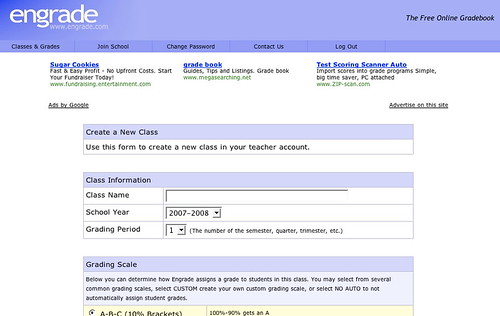
Engrade – http://www.engrade.com/ – is a wonderful teacher’s tool. If you want to share marks with individual students privately online, and aren’t on a Learning Management System like Desire2Learn, Moodle, or BlackBoard/WebCT, Engrade is just what you need. With Engrade you can post your students’ marks, and they can use the password you assign individually to see their marks. Plus you can then download your class records into an Excel worksheet and save them there.

It’s free and straightforward. You set up a class, add the students’ names, and give them their own individual password, (I did that by email). When you’ve finished marking an assignment, you add the marks to Engrade and make them accessible.

I used it with my 3rd year university students last term and it worked just fine. They checked their marks, I got some emailed queries, but I simply answered those, and found it far smoother than discussions about marks in class. Some after-class conversations still happened, but most students were happy with the system – if not the marks ;->

The best thing was that they had adjusted to their marks before they got their assignment or assignment comments back, and, when they got them back, could focus more on my feedback and less on the mark.

SlideShare on Blogging

I’ve mentioned SlideShare, the YouTube for presentations, before – http://elgg.net/vinall/weblog/134207.html  I like to browse it sometimes  and just read what I find. Dr. Steven Warburton has put up an interesting set of slides on student blogging – http://lookleap.com/slideshare.net/a1 – I recommend it, and using the full screen mode.

I found it quite interesting, a bit different from mine.

I used an Elgg Community Blog which gave my students some control over how public, or not, their post was, set topics, often based on current readings, and required they write in it for a portion of their marks. Oral Rhetoric was classroom based, but the frequent writing paired with personal icons, either their photos or a chosen image, created a kind of threading in which we could, with a quick glance, see who the writer was.

The setting of weekly questions scaffolded the students in learning how to use a blog, which many, if not most, were uncomfortable with, especially using it for an educational purpose. As I believe they will sometimes be using blogs for professional purposes in their futures, I wanted them to begin to understand that there are different genres of blogs, and different rhetorical approaches – which I’ve explored here,

I wrote up my opinion of blogs used as part of a learning / teaching strategy – http://elgg.net/vinall/weblog/145563.html  – I believe that that blogs can be used in many ways, and that they are especially important in creating learning communities.

technorati tags:,

Blogged with Flock

Free Applications for Education

From the blog  – AcademHack – http://academhack.outsidethetext.com/home/?p=51 – a list of tech tools for academics. The two I liked the looks of best are NeoOffice Aqua  – a free suite of office tools for Macs (For Windows, there’s OpenOffice, also free) and Google Apps for Education which is downloadable for free.

With Google Apps for Education, you can offer all of your students innovative email, instant messaging, and calendaring, all for free.* You can select any combination of our available services (see below), and customize them with your school’s logo, color scheme and content. You can manage your users through an easy web-based console or use our available APIs to integrate the services into your existing systems — and it’s all hosted by Google, so there’s no hardware or software for you to install or maintain. Find out more by reviewing detailed product information or attending an online seminar.

Google Apps for Education

I hope some educational administrators take advantage of this time-limited offer.

technorati tags:, ,

Blogged with Flock

VideoJug – How to do Just About Anything!

I was driving with the radio on, listening to CBC, and heard a description of a website called VideoJug that has short videos about how to do a wide variety of life necessities, and decided to check it out.

The videos I looked at are clear, short, easy to follow, and you can print up the instructions! Most are narrated with a lovely British accent, and the Aussie computer guys are funny.

Teachers might find it useful to show students how to give instructions clearly, and/or as a backup or reference to something they’re teaching. they might also find the instructions useful personally ;->

If you have a blocked toilet, or want to know how to use make-up to give yourself smoky eyes, or how to floss your teeth, or how to make a martini, just go to VideoJug – http://www.videojug.com/

technorati tags:, ,

Blogged with Flock

Convergence Learning & Class Blogs

Via Will Richardson – http://weblogg-ed.com/2006/more-henry-jenkins/ – quoting Henry Jenkins

In talking media pedagogies, then, we should no longer imagine this as a process where adults teach and children learn. Rather, we should see it as increasingly a space where children teach one another and where, if they would open their eyes, adults could learn a great deal. (Emphasis mine.)

Weblogg-ed » More Henry Jenkins

I used to have a page tacked to my bulletin board with a quote from Elliot Eisner – from a Google search, this reference – Elliot Eisner (in Saks (Ed.), 1996, p. 412)

“Working at the edge of incompetence takes courage.”

I thought this was true of all teaching, because we never know what our students don’t know, and how they can actually ‘get’ what we want to transmit convey help them learn. I also thought it was true of all teaching because, especially in rhetoric or English lit., my areas, views and rules change.

I also thought it was what made my learning, (and theirs) exciting. When you are at the vygotskian point in your proximal development that you mostly know and can venture into interweaving your own experiences and ideas into what you are getting from the mentor/experts (teachers, books etc.), it is terrifically exciting. Things click, synapses connect, and you are in a wonderful state of flow!

As a teacher, I can sometimes feel the class in this state, and I work to keep that liveliness happening. As a student, I am very good at helping move the class (if the teacher allows it) into a space where this is possible.

Last term I used an Elgg class blog with a 3rd year undergrad course in oral rhetoric, which I’ve blogged about before – here, and here. I’ve had trouble writing up a “final report” on my experience for two reasons.

  1. I had my students use Elgg and I feel (I think the best description is) shy. (Paranoia – “If they look, they will find it, anywhere on the Web, but they know how much I like Elgg, so they’ll know to look there.” Well, yes, but it is only my opinion and they are welcome to differ. I guess this is a trace of the Staff Room effect where you can say what you want, get as extreme as you want because you won’t be overheard. It’s also a bit of a response to the “Rate Your Teacher” effect. Time to get over that.)
  2. The Henry Jenkins quotation at the beginning of this post. I feel some ownership of the class, but they own their success. In their blog posts I could see how they began to expose where they needed help, and I could see some of their classmates helping.

Many of the students in the class began the interactive learning that I believe is the most powerful and natural way of learning. I set up the environment, but they taught one another. Those who were active with helping each other learned the most, and learned a pattern of learning that will benefit them the rest of their lives, I believe.

The best part for me, is how much I learned from watching them teach each other. Teaching and/or learning “at the edge of incompetence” is both exciting and valuable. And, with our rapidly changing and developing communication technologies, a necessity.

technorati tags:,

Blogged with Flock