Nurturing the [Blogging] Network

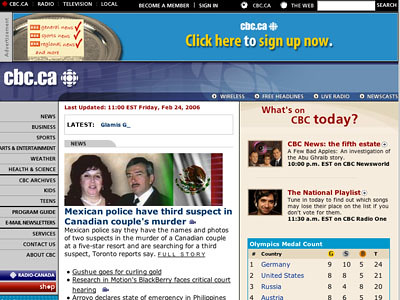
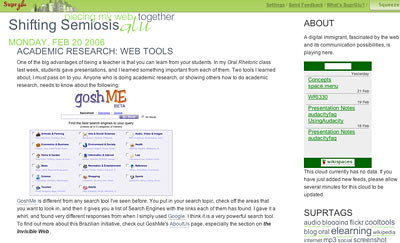
Clarence Fisher, a teacher for over 10 years, has an interesting blog called Remote Access.
RemoteAccess
As a teachers with students on a community blog, I found his post both insightful and helpful. Part of what he said was –

As teachers we need to be the leaders, and the “tenders” of our classroom networks, but just as importantly, we need to teach our kids how to do this. We need to teach them how to support each other in their growth and their understanding of the possibilities opened up by blogging. New forms of writing, new forms of connection, new opportunities for knowledge growth are all possible,

You might want to add his blog to your Bloglines (or other news aggregator) account.

tags

Blogging: Part of our Shifting Semiosis

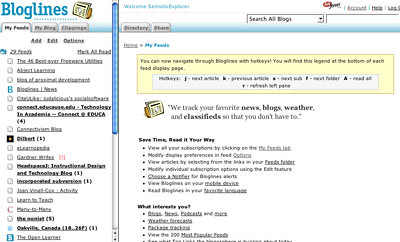
Often I harvest quotes from other people’s blog in order to encourage readers to check out the ideas there. Christian Long, in his think:lab blog, has a post called
thinklabhead
Blogging and the Changing Environment of Education and Collaboration is a long but well-written post and hits some of the central points about what is happening with the web, communications-in-general, and communications-in-education in particular.
In this excerpt, he sets the context:

We live in a remarkable world where the Internet has moved from a research experiment to a social curiosity to a dot.com frenzy to a normal part of each of our day-to-day existence. In many ways, schools and classrooms are at the center of it all. Computers are tools and in many ways similar to pens and radios and a screwdriver in the fact that they exist simply to help us do things. On the other hand, the raw existence of the Internet is something far more powerful. And what’s just beginning to unfold in blogging, podcasting, and other Web2.0 ways is even more impressive and curious.

In this excerpt he introduces readers to the power of the “read/write” web, often called Web2.0:

Blogging, on the other hand, explodes at the same moment that typical research begins to end…and this is the beginning of what is known as the Web2.0 world, or the second iteration or generation of the Internet. It is also known as the “read/write” web because by its very definition it only exists when the owner of a website and the audience interact, read and write together, share ideas, and collaborate. While the owner of the blog technically ‘owns’ the site, the information is truly open-source. Anyone that can find the website can write back, add information, and take the conversation in a new direction. And instead of a being merely a new ‘tool’, the power of the Web2.0 world and experiences like blogging is based upon the realization that information is no longer static and ‘owned’ by one individual or group. Information is collaborative and forever being added to or challenged or evolved.

In this final excerpt, Long shows his readers why this change has created a revolution in the way we humans communicate:

You see, blogging is merely a simple software tool. On the surface it’s merely a website with content and images. And if you stop by and look at one a time or two nothing really happens. You’ve seen a million sites like this. Check in, check out. But if you stick around for a bit, if you follow a link, if you add a comment or two, if you come back a few days later or weekly or even more often and see what’s been added, if you create a blog of your own, if you add the link to a friend’s blog or a classmate’s blog or a blog of someone from the other side of the world, and if you wake up one day and you receive an email from someone you’ve never met who wanted to tell you how much they appreciated your ideas on something you cared deeply about, then you begin to realize that something really powerful is happening in this Web2.0 world.

Those of us in the education field would do well to take advantage of the possibilites provided by the “read/write” web so our students can garner the learning provided by this communication tool.

tags


Tagging – a Research Tool

Even the most web-phobic sorts have to acknowledge that the internet is a profoundly powerful research tool. (Yes, there can be serious problems; I’ll post about authority another time.) However the advent of tagging has made researching and knowledge management much easier and more social.

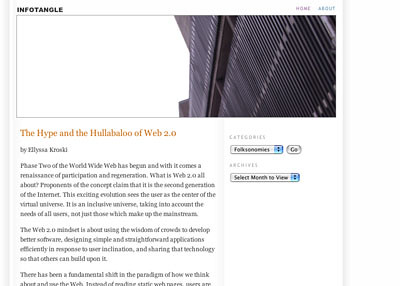
To get a fuller understanding, if the concept of tagging is new to you, I recommend Ellyssa Kroski’s post, The Hive Mind: Folksonomies and User-Based Tagging at InfoTangle.

InfoTangle

To give you the gist, here are some excerpts:

Today, users are adding metadata and using tags to organize their own digital collections, categorize the content of others and build bottom-up classification systems. The wisdom of crowds, the hive mind, and the collective intelligence are doing what heretofore only expert catalogers, information architects and website authors have done. They are categorizing and organizing the Internet and determining the user experience, and it’s working. No longer do the experts have the monopoly on this domain; in this new age users have been empowered to determine their own cataloging needs.

Web 2.0 is about sharing and connectivity and participation. It is a user-centered era of the Web. We are moving away from expert-dictated, exclusionary models of information organization and toward inclusive, participatory ones.

As users continue to add tags, a grassroots organizational scheme begins to emerge which has been dubbed by information architect Thomas Vander Wal, to be a folksonomy. A combination of “folks” and “taxonomy”, the term has come to mean a non-hierarchical ontology that is created as a natural result of user-added metadata or tagging.

The Wisdom of Crowds
There has been much discussion in the information world about the concept of folksonomy as opposed to the traditional taxonomy with its controlled vocabularies and hierarchical nature. Likewise, there have been many advantages identified with respect to folksonomies and organizing web content.

Finally, she says –

Summary
The advantages to top-down hierarchical taxonomies for library collections are without question. For cataloging the Web, however, they just aren’t feasible. The new, “voice of the people” approach of folksonomies emerges at a time when attitudes about information organization and retrieval are shifting and the technology is developing to support them. The opportunities for learning about user behavior as well as the implications for improving and/or complementing existing taxonomies that these systems can provide are of no small import. We are on the cusp of an exciting new stage of Web growth in which the users provide both meaning and a means of finding through tagging.

Kroski’s post is elegantly clear and informative, with academic referencing. To gain a clear understanding of the essentials of tagging, read the whole post!

tags


The Web, a Blog, and Communication

In my previous post, I talked about my Suprglu account and made reference to the fact that I hadn’t linked my Furl Archive – didn’t know how to;->

Lo and behold, I got a comment from Michael (of Furl) telling me how to add my Furl RSS. Thanks Michael! I took a longer look at Furl and found this – http://www.furl.net/faq.jsp#howShare

Now my Suprglu has a connection to my Furl Archive too!
suprgluSources

And I’m using Flickr to upload the screenshot, above, rather than the Blogger image icon, in the hopes that the Flickr image will show up in my Suprglu account – my Bogger uploaded image didn’t.

tags


My Suprglu

Suprglu http://www.suprglu.com/ is an interesting new web application that I have started using to have a home base for my various web adventures. Suprglu allows me to aggregate my web accounts into one place – my Suprglu account

I have included both my blogs, my more acedemic blog on Elgg and my Blogger blog, WebToolsForLearners, my Flickr account, my del.icio.us bookmarks, and my H2O Playlist on Poetry Basics. I haven’t figured out if I can (ans/or how to)add my Furl account, but most of my other separate individual web spaces are now “glued” together.

And that handy;->

tags

Higher Education – Out-of-Step with Society

David Wiley, in his blog, iterating towards openness, has some text from his testimony to to the US Secretary of Education’s Commission on the Future of Higher Education. He says –

In summary, higher education has fallen out of step with business, science, and everyday life. In order to realign itself with changes in society and in its student base higher education must find the will to innovate in the areas of openness, connectedness, personalization, and participation. I believe that openness is the key to enabling other innovations and catalyzing improvements in the quality, accountability, affordability, and accessibility of higher education. It is my recommendation that the Commission do everything within its power to promote a commitment to openness within higher education. In thinking about this work the Commission might fruitfully consider the many ways in which colleges and universities have collaborated with state and federal organizations to promote a culture of diversity in higher education.

Higher education in Canada needs the same openness to these kinds of innovations. We need to include the teaching and learning possibilites available through the web in our classes both as curriculum and as support for the curriculum.

tags


A Blog to Follow


One of the most rewarding blogs in my Bloglines is TechCrunch. From TechCrunch, I have learned about all kinds of new applications, many of which are free. I recently read about a learning management system there – nuvvo – which is web-based. It’s aimed at elearning, but I could see it being useful in a blended learning classroom environment as well.

Using Blogs as part of Teaching

Yes the web is overwhelming, and information (knowledge?) management is a huge issue. There are solutions, but it takes a while to find them and then get into the habit of using them. That’s the nature of the beast (feast)!

In my opinion, you do have to find a chunk of time almost every day but after the initial surveys of the terrain, you can decide on your focus and stay up-to-date in that area (depending on its breadth and complexity) with an aggregator (like Bloglines – which is free and easy to set up). I found this description of how a teacher could use Bloglines with a class really helpful – http://www.weblogg-ed.com/2004/03/03. After reading it I set up my own Bloglines account and now use it to track the educational blogs I’m interested in, scan their headings, and, if I’m interested in the topic, link to it and get the gist.

Blogs are being used more and more as part of teaching and learning. For a basic understanding of how to use blogs, check out Jakob Nielsen’s info – http://www.useit.com/alertbox/weblogs.html – He’s the senior acknowledged expert on web design.

http://www.weblogg-ed.com/why_weblogs provides an overview on using blogs in the classroom with lots of links to explore (Or not ;-> depending on your time and interest.)

Finally, here’s a link to a short video describing the uses of blogging in high school – http://www.weblogg-ed.com/weblogs_in_ed_video

A friend says –

My feeling is that we have to treat “computer reading” like people used to treat reading the newspaper in the past. It was an activity that occupied a certain part of everyday.

and I agree.

tags


Shifting Semiosis

Two or three years ago I began talking about a “shifting semiosis” and I felt like Cassandra – although I wasn’t prophesying a disastrous war, but rather a massive, fascinating and largely positive change. It was clear to me that we were at the start of a change in the way we humans signify meaning that would dwarf the printing press, audio & visual recording, and mass media combined. And now, in my daily newspaper, I find that my intuitive recognition is being substantiated.

I read an article, linked to this post’s title, in the Toronto Star, www.thestar.com – called Old Idea, New Media. The subheading asks this provocative question –

Are you reading this text on paper, or as pixels? Does it matter? Some think not.

As newspapers realize that they sell content, not ink, their future is taking hold.

I put down my paper and went immediately to my computer and read the same story in pixels, because I wanted to share this increasingly undeniable change. I wanted to blog about it.

The article is about how newspapers are still remarkably profitable (many at 20% a year!)about how newspapers are a natural fit as a web portal, about how the papers’ managers are finally beginning to realize that, and about how transportable digital downloads are coming. I picture these as much like ipods in function but looking more like paper or a book.

So, yes, our semiosis is shifting! Not that I expect any more attention to my message than Cassandra got to hers. (In some ways I wish I was more like Paul Revere;->)

The papragraph that electrified me, which follows, clearly indicates that the web is a platform, not a medium.

A newspaper of the future might employ web editors for each section of the paper whose task would be to rapidly accumulate multimedia content relevant to each story. Articles posted on reformulated newspaper sites will be accompanied by related photos, audio and video clips, speech transcripts, discussion forums and archival images from the CBC, CPAC, C-SPAN, the National Film Board and other partners.

Such wonders we are seeing as human communication continues its development

  • from speech and drawings
  • to (chirographic) writing
  • to printed text and engravings
  • to photography, audio recording, film, & television

and now to versions of all of these available asynchronously on the World Wide Web!