Social Software & Academic Commons

If you want to understand the “big picture” of the impact of social software on education, including the problems, I suggest you go to the Academic Commons and read Joseph Ugoretz”s Three Stars and a Chili Pepper
AcademicCommons

Ugoretz starts from this premise:
Social software includes many communication media, but the new tools which are the subject of this essay all fit three broad descriptions. These tools are interactive, with the content created and structured by a wide mass of contributors. These tools are also interconnected, with user-provided searchable links structuring and cross-referencing that content. And finally, these tools are bottom-up and communitarian, with the users of the tools providing and benefitting from associations, reputations, and authority within a many-to-many community. The various tools of social software are an increasing presence in the online world, as well as the offline lives of their users.

He uses anecdotes and clear explanations.

I recommend it.

tags

A New Resource for Learning

I’ve been playing on (with?) a new resource for learning and teaching called SocialLearning.ca
SocialLearning
You can learn a lot on this site. For direct learning, take a look at the Tutorials section – the link is on the far right on the navbar at the top.
Soclearn2
You can also learn by exploring a little using the (right)sidebar to click on tags or other links –
SocLearn3
And finally, you can learn by exploring the navbar at the top. For example, by clicking on “Software” you will find information on various software that SocialLearning.ca members recommend and/or describe.
If, as a teacher, you have trouble filling your time during the summer (;-> irony alert!) you could spend at least some of your “free” time exploring and learning from this site.

tags


Tagging – for Bookmarking Favorites

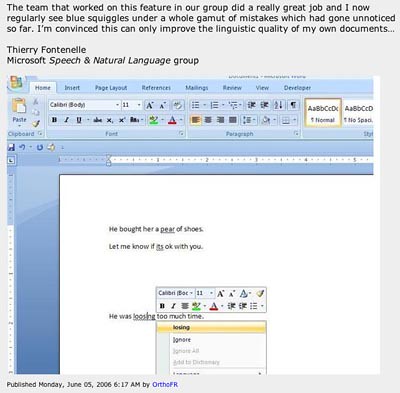
Tagging is an essential tool for anyone who wants to find interesting Websites again sometime in the future. In a previous post, I explained tagging, using extensive quotes from Ellyssa Kroski’s post, The Hive Mind: Folksonomies and User-Based Tagging at InfoTangle. It’s still an excellent starting point for understanding the significance of tagging. However, sometimes “quick and dirty” howto’s are all someone wants to know. With that in mind, here’s a link to –
TagTechSoup
Thirteen Tips for Effective Tagging, an excellent post on the “how’s” of tagging with del.icio.us. For example:

Below are some tips for choosing tags on del.icio.us from Web Consultant Alexandra Samuel.

1.
Be a lemming. Check how other people are tagging the kinds of sites you want to remember. Del.icio.us Linkbacks makes this very easy. Bear in mind that different people will bookmark the same site for different reasons: I might bookmark Terminus 1525 as a great example of a Drupal site, while you are saving it as a link to young Canadian artists.
2.
Follow the herd. When in doubt, pick the tag that seems to have the most links — this is the leading tag of the options you’re considering, so hopefully will emerge as the dominant focal point (so you don’t have to check “open-source,” “opensource,” and “open_source” to keep on top of the big world of open source).

I recommend the whole post, and suggest you bookmark it using del.icio.us ;->

tags


Matthew McKinnon on Web Megasites

CBCFreshMeet
The Web can be a confusing and therefore intimidating space. Matthew McKinnon, published on CBC’s Arts & Entertainment Website, gives the clearest map I’ve seen:

Think of the web’s old guard as TV networks — they provide mainstream programming for amorphous audiences — and its young turks as cable channels, offering niche content to avid subscriber bases.

The leaders of this new school excel at creating online communities. MySpace, YouTube and Flickr function as self-contained planets in cyberspace; Blogger is chief architect of the blogosphere. All of them encourage their users to contribute content, engage in conversation and form personal relationships. It’s a totally different tao of building traffic: Yahoo! takes you places, MySpace means you’re already there.

Settle in, and get a load of the big stars of the net’s new wave…

Here’s the link to his article: http://www.cbc.ca/arts/media/megasites.html.

Enjoy!

tags


Connecting the Dots – CCHRD’s 2006 Conference

CCHRDwiki
Some conferences are just great, and this was one. Today I attended the CCHRD (College Committee on Human Resources Development) Central Region (Centennial, Seneca, George Brown, Sheridan, Mitchner Institute) Conference called Connecting the Dots. The one & a half hour rush-hour commute was not fun, but shortly after I arrived, I was greeted by two women, one of whom, with a lovely warm smile, told me she reads this blog! It was exciting to meet a such a positive reader!

Then Dr Marcel Danesi spoke, and he’s wonderful! He talked about the fact that academic researchers don’t actually know how people learn, however the person and their background, both personal and cultural, are at the core. He went on to affirm that human contact is central to teaching. Yes. I agree totally.

As a teacher you have to shut up and listen, which is part of becoming wise, and part of seeing your students as researchers of what you both are interested in. Absolutely! You want your students’ respect, not their friendship. You want to be a “wise elder” and their mentor.

I can’t possibly impart the flair and humour of his talk, but I enjoyed and benefitted from it.

The students on the student panel had interesting comments and insights.

The morning workshop session I went to was called “Popular Culture and Critical Media Literacy” given by Lena Carla Gutekunst, and it was very interesting. She’s an engaging speaker with real insight into the culture many of our students live in, and how to teach critical thinking using (and respecting) it.

Lunch was great, as was the conference space Centennial had provided.

I presented on Blogs, Wikis and Students in the afternoon, and was grateful for the help I got from the sound man and a quiet stranger I later realized was Dr. Sandy Shugart, the closing keynote speaker. I loved talking about Web 2.0, and how it helped my students connect with each other, and how it gave them a real context for communicating with each other. (If they didn’t reseach, present and post on the wiki, their fellow students wouldn’t learn what they needed to learn.) And the subtext to both the class and the presentation, was that my students had engaged with each other because they had heard each other’s stories, and had been heard when they told their stories.

The Web, my message was, is easy and allows our students to communicate in ways they find meaningful, using a technical tool they are familiar with, though they might have to learn some new elements. It is a powerful teaching/learning tool, especially when combined with face-to-face time in class.

Dr Sandy Shugart gave the closing keynote and what a wonderful note to close on. He spoke holding, and occasionally playing his guitar. He talked about Robert Frost’s “Two Tramps in Mud Time” and how our work can deform us, how it can be a shrinking prison, or how it can be a crucible, where we are transmuted into our full humanity. He spoke about how important it was to a “servant leader” – and he sang great lyrics. I was very glad I’d stayed (instead of leaving early to miss the traffic). I needed to hear what he was saying, at many levels. Here’s a description of him – http://www.imakenews.com/orcc/e_article000400176.cfm?x=b11,0,w

A lovely, rewarding day!

tags


Cool Cat Teacher

Vicki Davis’s students explain the difference between a blog and a wiki.

Synopsis of their posts
The most meaningful point that they have brought out for me is that they see wikis as a place to share information and they see blogs as a place to share opinions and discuss.

CoolCatTeacher
For more detailed versions of her students comments – go here

mesh06 – Reflections

mesh
Looking back on mesh
Of course my first observation is that I had fun and learned a lot. Those are my two central requirements, and they were certainly fulfilled. Can’t ask for more.
Venn
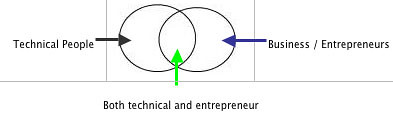
Last year at a college conference in North Bay, I noticed something significant, and I could see it again at mesh. The Web used to have distinct groups, especially at conferences. The technical people gathered and talked about java and ruby-on-rails and other obscure (to me) topics. Teachers, or in the case of mesh, PR, marketing, and business people (Web entrepreneurs), got together to discuss how to use the Web.

Both at This is IT in North Bay last spring, and here at mesh this spring, I see the two formerly distinct (except in rare cases) groups starting to overlap. There is a Web culture that includes engineers and communicators, and I see the business actions as coming from the middle, the overlap, where we are in the same space with similar enough understandings that we can disagree. (If you don’t have similar maps and language, you can’t communicate enough to argue ;->) A fascinating development.

So I see the emergence of a strong Web culture with segmented areas attached to it.

Other Observations
The conference had an interesting mix of (Web) business, PR/marketing, and engineers. I noticed a few differences from academic conferences – which is what I’m used to.

  • more hands are shaken more often;
  • more business cards are exchanged;
  • people move on from conversations more often; there’s a faster pace;
  • the attendees were not as old in general as at academic conferences, but the conference wasn’t as skewed towards youth as I expected. I would say most attendees were from 30 to 50, and there were more older than younger. Would love to hear from someone who found it different.

I did encounter a couple of misogynist moments.

  • I overheard, in the lunch lineup first day, two guys talking about a woman who was “too aggressive”. They used the phrase repeatedly. It turned out they were talking about someone who didn’t share back business contacts and information. (Hey, the lunch lineup was long and I couldn’t help overhearing!) The phrase “too aggressive” has more negative connotations when applied to a woman than when applied to a man, and it is rarely applied to a man. “Aggressive” is a complimentary term when applied to a male. I have yet to hear people talking about a man who is “too aggressive” when what they mean is he doesn’t share business contacts and information. They usually skip the negative definition and get straight to the information, maybe adding that he’s an “a**hole” which is a nicely non-gendered perjorative.
  • I saw in one of the blog comments, a reference to “that Tara chick”. I can’t even imagine someone referring to “that [insert male name] pup”. And she was criticized for preparing an interesting presentation that enacted what she was describing. I am NOT being critical of the interview approach (I liked it) but it takes less work to prepare for.

    On a related topic, my husband, after watching a public school talent show, commented that the boys got more applause for ballsy improvisation than the girls did for skill and preparation. I think some of that mindset is still there in less mature men.

So mesh was fun, amusing, educational, and provided grist for my tendancy to engage in analytical observations.

tags

mesh – Viable Web Applications

Live blogging is something I saw Stephen Downes do last year at the This is IT Conference in North Bay. As I watched him blog during the sessions, I wondered how and why he did it. I can’t answer for him but now that I’m blogging my way through mesh, I’m finding it helps me focus! It’s not doing 2 things aat once, it’s sort of like taking notes in a lecture, where you ‘get’ more of what’s being said because you write it down.

I’m in Idee‘s Leila Boujnane’s session on Creating a Viable Web Business, with Michael McDerment of FreshBooks, Malgosia Green of Nuvvo and Albert Lai of Nuvvo
They are describing the start-up mistakes they made, and what they would do differently if they were to do it over.

  • Being flexible and responding to change seems to be central. Feedback is essential.
  • Different patterns for getting your name out, some through the blogosphere, some more traditional newsletters etc. plus the blogosphere.
  • Making things simple to use and having good customer support are really important
  • Different approaches for tech support, one by phone, others by email and forums
  • Your tech support can be your sales department – you build loyal users who stay and refer others
  • Nuvvo – most users are free, then they can subscribe for more robust services. The free users are more forgiving of weak support.
  • Bubbleshare and Idee find customers want to help each other, (like on MySpace)
  • This conference – mesh http://www.meshconference.com/ – was advertised by 4 guys writing on their blogs, and the news spread.
  • simplicity of use, a fluid user-experience, is what users find attractive. Design for these, not for elite super-users
  • Understand the purchasing process of your customers, and it’s different for different applications
  • Set up almost a funnel – first someone looks, then a free trial, then full users – about 5% of the lookers
  • Raising money takes a lot of time
  • Recruiting talent is tricky
  • Knowing enough to know how to communicate with employees is important, worth taking some courses in their areas.
  • churn is scary but a chance to learn
  • mentors are a real help

tags


mesh – Day 2, more – Tara Hunt

Tara Hunt http://www.horsepigcow.com/ – From Toronto – a former online marketing manager
Discovered the blogosphere, recruited through her blog and joined Silicon Valley .
BarCamp showed her both world and Toronto’s tech communities

What does this mean for the future of marketing?
We discussed this in small groups, and interestingly, there is an immediate distrust of the authenticity – in this group!
Bowiechick isn’t an “expert”; she’s a user and others would identify with her.
Many would trust bowiechick more than a TV commercial.
Tara suggests – “Go pinko!”
Pinko Marketing Principles
#1 inbound, rather than outbound messages
#2 you advocate to your company, not for your company
#3 100% authenticity (Stop using the word “viral”!)
#4 serve niche markets – the long tail Riya http://www.riya.com/ will soon have a Mac Uploader
#5 open source – wikis etc.
“Snakes on the Plane” – literally changed by the blogosphere, huge buzz
The blogosphere is the source of so many stories, but how do we bring social translucency into systems – evangelism – change your institution!

Is there a danger of community turning into just marketing?
You have to be part of the community you serve.

Reputation becomes part of it. You have to be in the community and build relationships over time, just like anywhere!

tags